

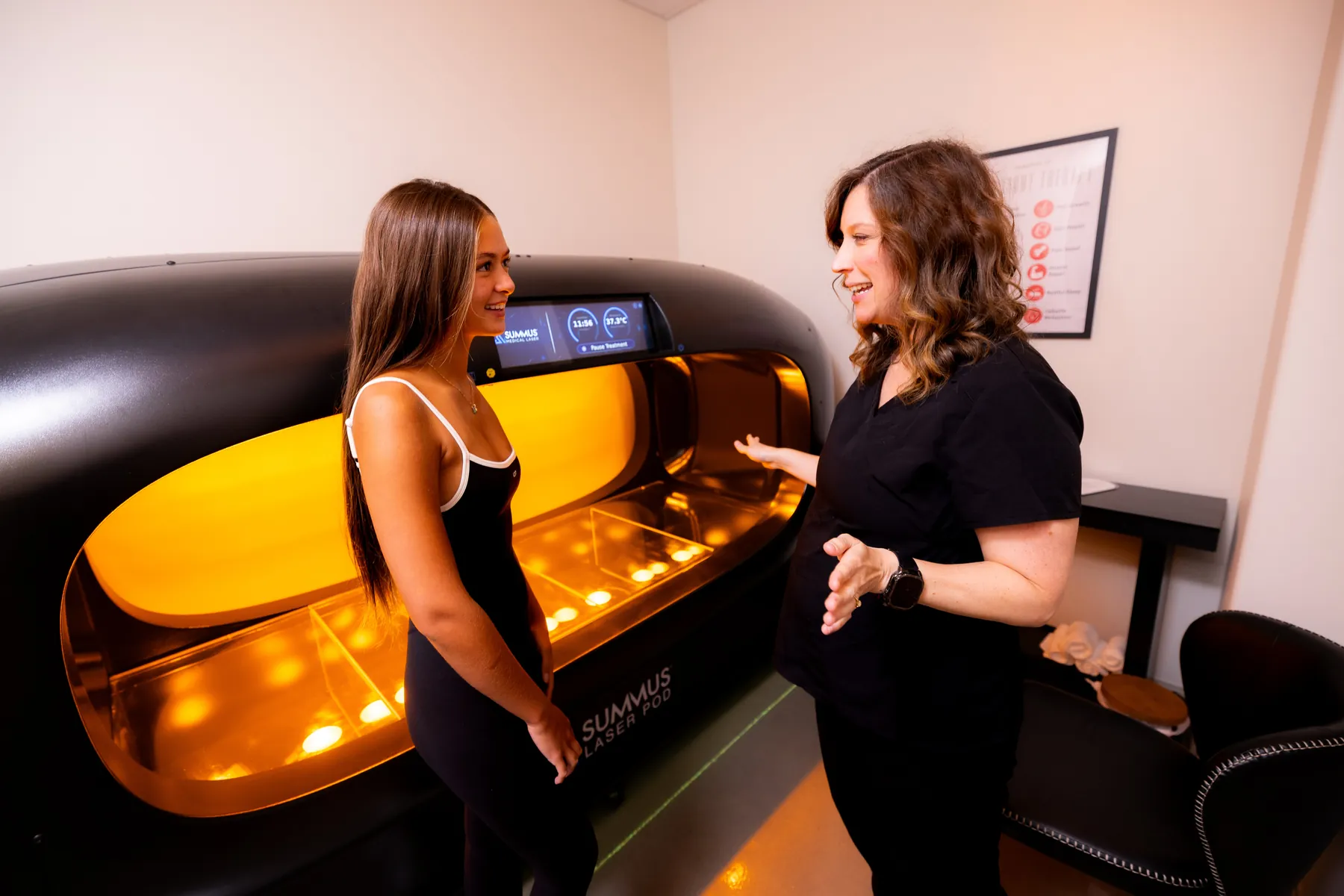
- Same mechanism as red light therapy — light absorbed by cytochrome c oxidase in your mitochondria, raising ATP output and reducing oxidative stress.
- The difference is dose concentration. A laser delivers far more energy to a small area than a bed delivers to any one part of you.
- “Cold” means non-thermal — it does not heat or cut tissue, which is what separates it from surgical lasers.
- The evidence for musculoskeletal pain is genuinely good, with multiple meta-analyses and inclusion in several clinical guidelines.
- Dose matters more than almost anything. Under-dosed treatment is the most common reason a patient reports it did nothing.
How cold laser actually works
The mechanism is the same photobiomodulation story that underlies red light therapy, delivered in a concentrated form.
Light at specific wavelengths — typically in the red and near-infrared range — is absorbed by cytochrome c oxidase, the final enzyme in the mitochondrial electron transport chain. That enzyme has absorption peaks in exactly this part of the spectrum.
When it absorbs that light, nitric oxide that had been inhibiting the enzyme is released, the electron transport chain runs more efficiently, and ATP production rises. A brief signalling burst also switches on the cell's own antioxidant and repair machinery.
The word “cold” distinguishes this from surgical lasers. There is no thermal effect, no cutting, no tissue damage. What is being delivered is a signal, not heat.
What makes laser distinct from LED is coherence and concentration. Laser light is coherent — the waves are in phase — and it is delivered through a small applicator, which means a far higher energy density into a small volume of tissue. For an injured tendon or a specific joint, that concentration is precisely what you want.
Same mechanism, different dose
Cold laser versus a full-body light bed
These answer different questions. If you have an inflamed Achilles tendon, a laser puts a therapeutic dose into that tendon in ten minutes. If you want systemic effects — sleep, recovery, skin, mood — the bed treats every tissue at once and the laser cannot.
In practice both are used, frequently for the same patient, because a person with a specific injury usually also benefits from the systemic work.
What the evidence supports
Low-level laser therapy has one of the more substantial evidence bases in physical medicine, and it is worth knowing where it is strong.
Musculoskeletal pain is the best supported. Multiple systematic reviews and meta-analyses have found benefit in neck pain, low back pain, and chronic joint conditions, and low-level laser appears in clinical practice guidelines for several of these.
Tendinopathy — particularly Achilles, patellar and lateral epicondylitis — has positive trial evidence, especially when combined with loading exercise rather than used alone.
Wound healing and post-surgical recovery have a long history of positive findings, and this is one of the older applications of the technology.
Oral mucositis in cancer treatment is an interesting case: photobiomodulation is now recommended in several international supportive care guidelines for preventing and treating mucositis during chemotherapy and radiation.
The single largest determinant of whether it works is dose. The literature is clear that there is an effective window, and both under-dosing and over-dosing reduce the effect. This is why treatment protocol matters more than which device a clinic happens to own.
The ten problems cold laser is used for
Ranked by strength of evidence and how reliably they respond.
Chronic Neck and Low Back Pain
Among the best-evidenced applications, with multiple meta-analyses reporting benefit and inclusion in clinical guidelines. Works best alongside the movement and strength work that addresses the underlying cause.
What the evidence showsLow-level laser therapy delivers coherent light at wavelengths absorbed by cytochrome c oxidase, increasing ATP production and reducing oxidative stress in the treated tissue.Tendinopathy
Achilles, patellar and lateral epicondylitis all respond, and the evidence is strongest when laser is combined with loading exercise rather than used alone. That combination is the one that tends to work.
What the evidence showsMeta-analyses of low-level laser therapy for musculoskeletal pain have found consistent benefit, and Bjordal and colleagues established location-specific dosing parameters that predict response.Osteoarthritis Pain
Multiple trials report reduced pain and improved function in knee osteoarthritis. The near-infrared wavelengths penetrate to the joint capsule, which is what makes this mechanistically sensible.
What the evidence showsLaser light is coherent and collimated, allowing higher energy density delivery to a small target area than diffuse LED sources, which is the argument for laser in focal conditions.Wound Healing and Scars
One of the oldest applications, with a long history of positive findings. Accelerates closure and improves the quality of the resulting scar tissue.
What the evidence showsRandomised trials support low-level laser for lateral epicondylitis, Achilles tendinopathy and plantar fasciitis, with results depending heavily on adequate dose reaching the target depth.Post-Surgical Recovery
Reducing swelling, supporting tissue repair and easing post-operative pain. Applied around the surgical site once wound closure allows, with your surgeon's timing.
What the evidence showsPhotobiomodulation reduces inflammatory mediator production and increases local microcirculation, addressing both components of persistent soft tissue pain.Oral Mucositis
Photobiomodulation is recommended in several international supportive care guidelines for mucositis during chemotherapy and radiation — a genuinely well-established use that few patients are offered.
What the evidence showsLow-level laser has documented effects on nerve regeneration in experimental models and is used clinically in peripheral neuropathy with reported symptom improvement.Plantar Fasciitis
Responds, and frequently used alongside shockwave. Where a patient cannot tolerate shockwave, laser is a gentler alternative that works through a different mechanism.
What the evidence showsLaser therapy accelerates wound healing through increased fibroblast proliferation and collagen synthesis, one of the earliest and most reproduced applications.Carpal Tunnel and Nerve Entrapment
Positive trial evidence for symptom relief, and a reasonable option to try before surgical consideration in mild to moderate cases.
What the evidence showsTrigger point application produces local muscle relaxation and pain reduction, with proposed mechanisms including improved local perfusion and altered nociceptive signalling.TMJ and Jaw Pain
The temporomandibular joint is superficial and easy to target accurately, which suits laser well. Reasonable evidence and a straightforward application.
What the evidence showsDose is the primary determinant of outcome. Insufficient energy delivery produces no effect, and the biphasic dose response means excessive delivery can inhibit rather than stimulate.Acute Sports Injury
Applied early after a soft tissue injury to support the healing process. Less evidenced than the chronic applications and mechanistically reasonable.
What the evidence showsCold laser and full-body photobiomodulation are complementary rather than competing — laser for a specific focal target, full-body beds for systemic effect across all tissue simultaneously.What people commonly experience with this therapy
When patients receive the proper guidance, here is what people commonly experience with it.
- During the session — usually nothing. Cold laser is non-thermal, so most patients feel little or nothing at all. Some notice a mild warmth. It is not uncomfortable and requires nothing of you.
- Sessions 1–3 — the first change. Acute problems frequently respond quickly. Chronic conditions typically take longer, and this is where patients need to know in advance that a single session tells you very little.
- Sessions 4–8 — the substantive change. Most protocols run six to twelve sessions, and this is where the benefit accumulates. Pain reduction usually precedes functional improvement.
- After the course — function. What we actually track: range of motion, activity tolerance, and how much pain medication is still needed. Pain scores alone can mislead in either direction.
If you have a specific injured structure that has not resolved, cold laser is a straightforward, low-risk option worth considering. Schedule a consultation and let my team assess what is actually going on in that tissue, and whether laser, shockwave, prolozone or something systemic is the right answer for you. We will not stop until the root cause of every one of your health issues has been found and addressed.
Proper assessment first, then the tool that fits — laser, shockwave, prolozone or the systemic work underneath.
Common questions
What is cold laser therapy?
Low-level laser therapy delivers coherent light at red and near-infrared wavelengths into a specific tissue. It is absorbed by cytochrome c oxidase in your mitochondria, raising ATP production and switching on the cell's own repair machinery. "Cold" means non-thermal — it does not heat or cut tissue.
How is cold laser different from red light therapy?
The mechanism is identical; the delivery is not. A full-body light bed treats every tissue at moderate intensity. A laser puts a much higher energy density into one small area. For a specific injured structure the concentration is the point; for systemic effects the bed is what you want. We often use both for the same patient.
Does cold laser therapy actually work?
For musculoskeletal pain the evidence is genuinely good, with multiple meta-analyses and inclusion in clinical guidelines for conditions including neck and low back pain. Photobiomodulation is also recommended in international supportive care guidelines for oral mucositis. The largest determinant of whether it works is dose, and under-dosing is the most common reason patients report no effect.
How many cold laser sessions will I need?
Typically six to twelve, depending on whether the problem is acute or chronic. Acute problems often respond within a few sessions; chronic tendinopathy and joint conditions take longer. A single session tells you very little, which is worth knowing before you start.
Does cold laser hurt?
No. It is non-thermal, so most patients feel nothing at all and some notice a mild warmth. There is no downtime and nothing is required of you during the session.
- Chow RT, Johnson MI, Lopes-Martins RA, Bjordal JM. Efficacy of low-level laser therapy in the management of neck pain: a systematic review and meta-analysis of randomised placebo or active-treatment controlled trials. The Lancet. 2009;374(9705):1897–1908.
- Bjordal JM, Couppe C, Chow RT, et al. A systematic review of low level laser therapy with location-specific doses for pain from chronic joint disorders. Australian Journal of Physiotherapy. 2003;49(2):107–116. PMID 12580887
- Zadik Y, Arany PR, Fregnani ER, et al. Systematic review of photobiomodulation for the management of oral mucositis in cancer patients. Supportive Care in Cancer. 2019;27(10):3969–3983.
- Hamblin MR. Mechanisms and applications of the anti-inflammatory effects of photobiomodulation. AIMS Biophysics. 2017;4(3):337–361. PMC5523874
This article is educational and reflects the published literature as of August 2026. It is not a diagnosis or a treatment recommendation for any individual, and any decision about your care belongs in a conversation with a licensed practitioner who has seen your history and your labs.