

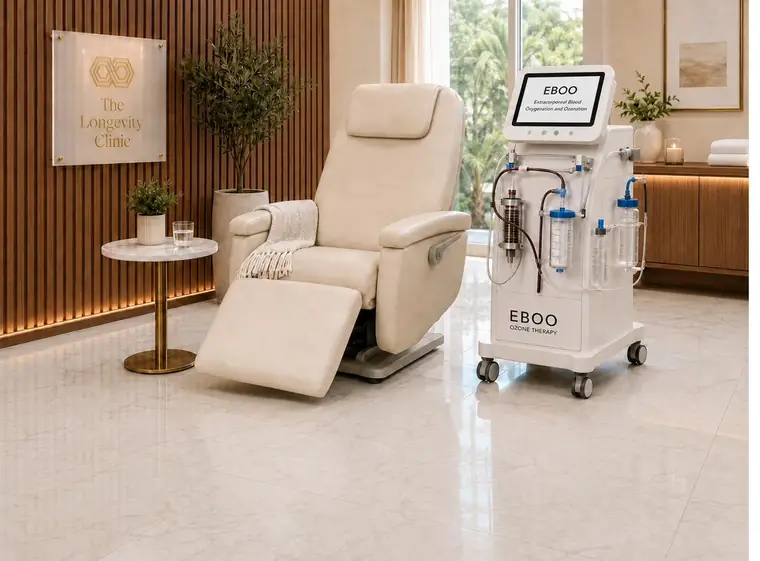
- Ozone works by hormesis — a brief, controlled oxidative signal that switches on your own antioxidant enzymes, leaving you better defended afterwards.
- The methods are not interchangeable. Volume ranges from about 200 mL in a standard MAH to 4,800 mL in EBOO, and that difference decides what each one is for.
- Insufflation is the gentlest entry point and the one most people should start with. No needle, no blood draw, and genuinely useful.
- G6PD is screened before any of it. That single inexpensive test turns the only serious risk of ozone therapy into a known quantity.
- Medical ozone is made from pure oxygen, never from ambient air, and it is never inhaled.
How ozone works, and why it is not an antioxidant
The mechanism is counterintuitive and it is the most interesting thing about this therapy.
Ozone is an oxidant. When it meets blood it reacts almost instantly with lipids and proteins in plasma, producing a small, short-lived wave of reactive oxygen species and lipid oxidation products.
Those molecules do not persist. They act as messengers. They signal the cell that oxidative pressure has risen, and the cell responds by switching on the Nrf2 antioxidant programme — producing more glutathione peroxidase, superoxide dismutase and catalase.
The result is a system that is better defended after treatment than before it. That is hormesis: the same principle behind exercise, fasting and heat exposure. A stress small enough to be survivable and specific enough to be useful.
Alongside that, ozone is directly germicidal — it inactivates bacteria, viruses and fungi on contact by oxidising the cell envelope, which is why organisms do not develop resistance to it the way they do to antibiotics. And it improves red blood cell flexibility and oxygen offloading, so more oxygen actually reaches tissue.
Every method, compared
How we choose between them
The right method depends on what you are treating, how much load you are carrying, and how you have responded so far.
Start with insufflation if you are new to ozone, needle-averse, or want to see how you respond before committing to anything more involved. It is genuinely useful and it is the lowest barrier in the field.
Step to MAH for systemic work — chronic fatigue, immune support, general inflammatory load. It is the most widely used ozone therapy in the world for good reason.
Escalate to 10-pass or EBOO where the load is genuinely heavy: chronic infection, mold and biotoxin illness, long-standing Lyme, or where MAH has been tolerated and the response suggests more is warranted. EBOO specifically where filtration adds something.
Prolozone is a separate decision, and one we also offer. It is local, it treats joints and soft tissue, and someone may be a good candidate for it and a poor candidate for systemic ozone, or the reverse.
What decides it in practice is your history, your inflammatory markers, your infection panel where relevant, and your drainage capacity. Which is why the conversation comes before the treatment.
The screening that should come first
Ozone is well tolerated in trained hands. The screening is what makes that true rather than lucky.
G6PD deficiency is the one that matters most. Glucose-6-phosphate dehydrogenase is the enzyme protecting red blood cells from oxidative stress, and it is essentially their only defence. About one in twenty people carries some deficiency and almost none of them know. One inexpensive test, done once in a lifetime, settles it before anyone sits down.
Iron status, read as a pair. Low ferritin with high transferrin saturation means iron moving fast with nothing in reserve, and free iron catalyses exactly the reactions ozone sets off.
Not appropriate: pregnancy, active bleeding disorders, hyperthyroidism, recent myocardial infarction, and certain anticoagulant situations.
And whether you are likely to Herx. Die-off reactions are common in people carrying a heavy infection load — which is the same group that benefits most. For anyone likely to react strongly we start at a lower concentration, confirm drainage is open first, and space the early sessions further apart.
The ten reasons people come for ozone therapy
Ranked by how directly the mechanism applies and how consistently we see a response.
Chronic Inflammatory Load
The core use and the clearest mechanism. Ozone does not act as an anti-inflammatory drug — it raises oxidative signalling briefly so your own antioxidant and anti-inflammatory systems come up. You are being taught to make more of your own rather than being given a substitute.
What the evidence showsOzone generates short-lived reactive oxygen species and lipid oxidation products that upregulate the Nrf2 pathway, increasing endogenous glutathione peroxidase, superoxide dismutase and catalase. Bocci characterised this mechanism extensively.Chronic Infection, Lyme and Co-Infections
Ozone is directly hostile to anaerobic organisms, and a great many of the pathogens behind chronic infection are built for low-oxygen environments. Used alongside drainage support and never before the exit routes are open.
What the evidence showsAnaerobic organisms lack the antioxidant enzyme systems that protect human cells from oxidative stress, creating the therapeutic window. Ozone oxidises microbial cell envelopes without a resistance mechanism developing.Mold Illness and Biotoxin Burden
Where filtration matters, EBOO specifically. In biotoxin illness the problem is an immune system stuck in a loop plus a body struggling to clear what it was exposed to, and physically removing material from the circuit is a different proposition from ozonating alone.
What the evidence showsEBOO uniquely combines ozonation with dialysis-style filtration, physically removing inflammatory mediators and cellular debris. Di Paolo and Bocci described the technique and its clinical application in Redox Report.Post-Viral Illness and Long COVID
Smouldering inflammation, poor microcirculation and mitochondria that have forgotten how to make energy — the pattern ozone therapy was originally developed to address in vascular medicine. One of the most common reasons people call us.
What the evidence showsOzone improves red cell deformability and oxygen offloading, addressing the impaired microcirculation documented in post-viral syndromes.Circulation and Vascular Health
The founding indication. Ozone improves red blood cell flexibility and oxygen offloading and triggers nitric oxide release that relaxes vessel walls. The original clinical work was in severe peripheral arterial disease and it remains the best-documented use.
What the evidence showsEBOO was developed for severe peripheral arterial disease unresponsive to conventional treatment, and vascular application remains the best-documented indication with the longest clinical track record.Joint Pain — Prolozone
A genuinely different application, and one we also offer. Ozone injected into a joint or soft tissue alongside nutrients and anaesthetic, prompting local repair rather than systemic change. Knees, shoulders and low back are the common targets.
What the evidence showsProlozone combines ozone with procaine and nutrients injected intra-articularly, prompting a controlled local inflammatory and repair response rather than suppressing the pain signal.Autoimmune Conditions
Ozone modulates rather than stimulates immune function, which is the distinction that matters in autoimmunity. Used alongside your rheumatologist rather than instead of them.
What the evidence showsOzone modulates rather than stimulates immune function, shifting cytokine profiles toward regulation — the mechanism relevant in autoimmunity where broad immune stimulation would be counterproductive.Fatigue and Mitochondrial Function
Better oxygen offloading means more oxygen actually arriving where mitochondria are trying to make energy. Patients frequently report a lift in energy and clarity within the first few sessions, often before anything moves on a lab.
What the evidence showsImproved oxygen offloading raises oxygen availability to mitochondria. Patients typically report subjective energy change before laboratory markers move, consistent with a delivery rather than synthesis mechanism.Dental and Localised Infection
Ozone is used in dentistry for exactly the reason it works elsewhere — it is directly antimicrobial without driving resistance. Localised applications are among the least controversial uses.
What the evidence showsOzone is used in dentistry for caries management and periodontal disinfection, where its direct antimicrobial action without resistance development is well established.General Resilience and Longevity
People come for ozone with nothing acutely wrong, on the same logic as sauna or cold exposure: a controlled brief stress that leaves the system more resilient. That is real hormesis, and it is also the least studied use on this list.
What the evidence showsLeón Fernández and colleagues characterised ozone oxidative preconditioning as protection against free radical damage, establishing the hormetic mechanism experimentally in Mediators of Inflammation.What patients commonly experience under our care
When patients receive the proper guidance, here is what they commonly experience under our care.
- Sessions 1–2 — energy and clarity. Better oxygen offloading means more oxygen reaching the tissue that needs it, and the brain registers that first. Often described as the fog moving, and it typically arrives before anything changes on a panel.
- Sessions 2–4 — sleep and circulation. Nitric oxide release relaxes vessel walls, so cold hands and feet frequently warm up early. Sleep tends to deepen alongside, and aching eases as inflammatory signalling settles.
- Sessions 4–8 — the panel moves. hs-CRP falling. Fibrinogen and ESR down. Ferritin normalising as the inflammatory drive settles. For those carrying an infection load, this is often where the corner gets turned.
- Across a course — stamina. Energy that holds through a full day rather than requiring the afternoon to be negotiated. Some patients move through a die-off phase before this, which is why drainage comes first.
If you have been carrying an inflammatory or infectious load for years, there is more available to you than you have been told. Schedule a consultation and my team will find the root of what is driving it, then tell you honestly which method fits — or whether something else should come first. Care from people who are genuinely invested in your outcome.
That is exactly what the consult is for. We will look at your history and your labs and tell you honestly which method fits — or whether to start somewhere else entirely.
Common questions
What is the difference between MAH, 10-pass and EBOO?
Volume and continuity. Major autohemotherapy treats around 200 mL of blood in a single pass. Ten-pass repeats that cycle roughly ten times under pressure, totalling around 2,000 mL. EBOO runs a continuous circuit rather than batches, processing up to 4,800 mL while also filtering material out through a dialysis-style membrane. They are escalating levels of the same principle.
Which type of ozone therapy should I start with?
For most people, rectal insufflation or standard MAH. Insufflation requires no needle and no blood draw, is well tolerated and is genuinely useful. MAH is the most widely used ozone therapy in the world and a sensible systemic starting point. Escalation to 10-pass or EBOO makes sense once you know how you respond and where the load justifies it.
Is ozone therapy safe?
In a clinical setting with proper screening, the safety record is good — published reviews put adverse event rates well under one in ten thousand treatments. The screening is what makes that true: G6PD before any ozone, iron status read as a pair, and a review of medications and history. Ozone is never inhaled.
Does ozone therapy hurt?
Insufflation is painless. MAH and 10-pass involve a single IV line; EBOO requires two, one in each arm. The needle is the only uncomfortable part and it takes a moment. During treatment most people feel nothing, though some notice a mild metallic taste or slight lightheadedness early on.
How many ozone sessions do I need?
It depends on the method and the load. Insufflation is often done frequently, sometimes several times weekly. MAH courses typically run six to ten sessions weekly or fortnightly. EBOO courses are usually six to ten. Maintenance afterwards is commonly monthly or quarterly.
Is ozone therapy widely used?
Very. Medical ozone has been used clinically for over four decades and is regulated, taught and routinely practised in Italy, Germany, Spain, Russia and Cuba, with professional societies and published protocols behind it. In the United States it is provided by licensed physicians under the practice of medicine, which is why it belongs in a clinical setting with proper screening.
- Bocci V. Ozone: A New Medical Drug. 2nd edition. Springer, 2011.
- Martínez-Sánchez G, et al. Therapeutic efficacy of ozone in patients with diabetic foot. European Journal of Pharmacology. 2005;523(1-3):151–161. PMID 16198334
- Di Paolo N, Bocci V, Gaggiotti E. Extracorporeal blood oxygenation and ozonation. Redox Report. 2005. PMID 16156950
- León Fernández OS, et al. Ozone oxidative preconditioning: a protection against cellular damage by free radicals. Mediators of Inflammation. 2008.
This article is educational and reflects the published literature as of August 2026. It is not a diagnosis or a treatment recommendation for any individual, and any decision about your care belongs in a conversation with a licensed practitioner who has seen your history and your labs.