

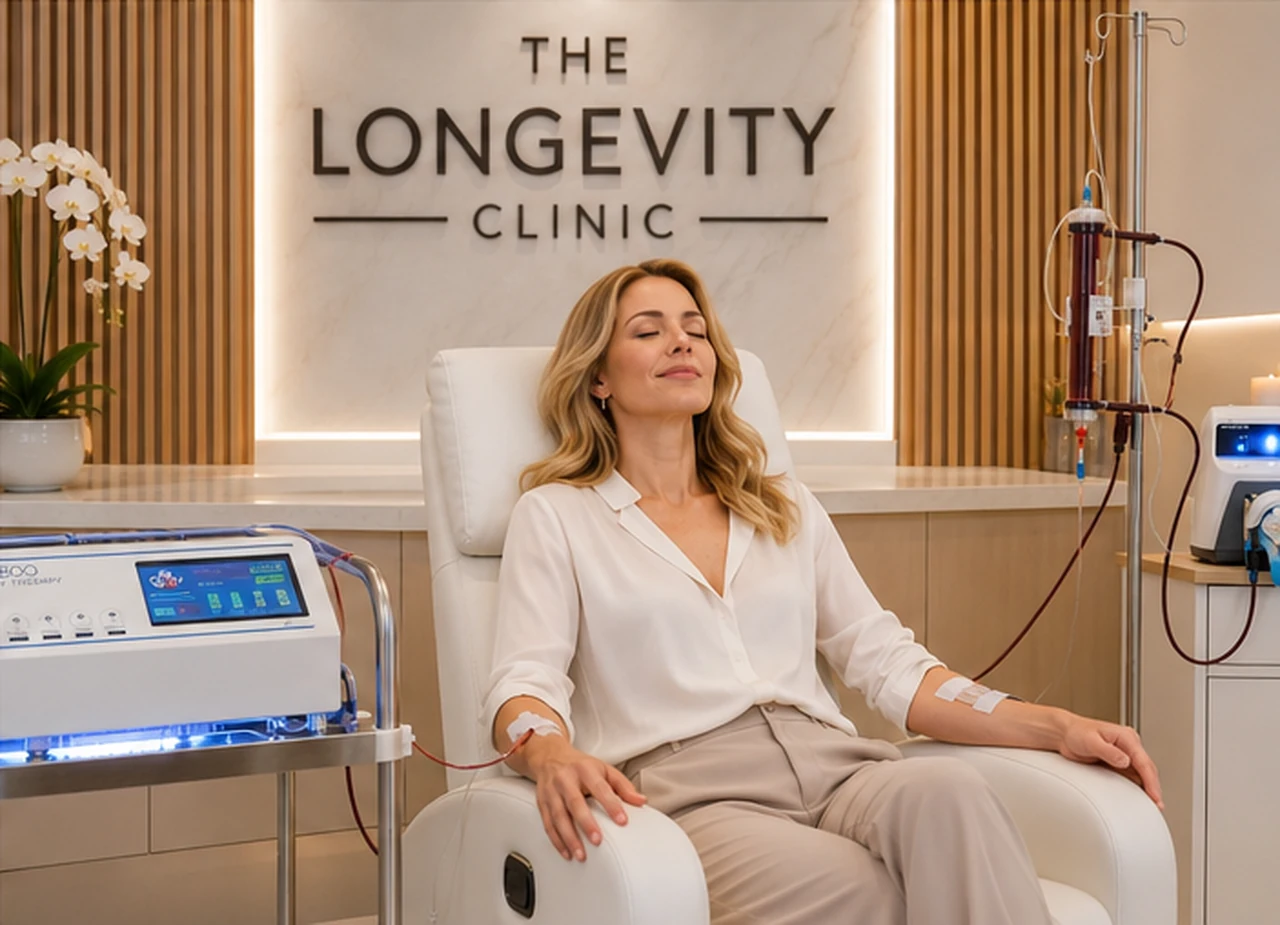
- EBOO filters and ozonates up to 4,800 mL of blood in a single session — roughly your whole blood volume, against about 200 mL in a standard ozone IV.
- It works by hormesis. A brief, controlled oxidative signal switches on your own antioxidant and anti-inflammatory systems. You are not being given an antioxidant; you are being taught to make more.
- The filter is what makes EBOO different from every other ozone method — material is physically removed from the circuit, not just treated.
- It is the therapy patients most often describe as the turning point — particularly people who had already done the diet, the sleep and the supplements and were still stuck.
- We check G6PD and iron first. One inexpensive test turns the only genuinely serious risk into a known quantity before you sit down.
What EBOO actually is
EBOO stands for extracorporeal blood oxygenation and ozonation. In plain terms: your blood leaves one arm, travels through a filter and an oxygen-ozone exchange chamber, and returns through the other — continuously, for sixty to ninety minutes.
It was developed in the late 1990s by Dr. Nicola Di Paolo, an Italian nephrologist, working alongside Professor Velio Bocci, the researcher who did more than anyone to put ozone therapy on a scientific footing. Di Paolo came at it from dialysis: if you can run blood through a semipermeable membrane to clean it, you can run blood through a membrane to oxygenate and ozonate it. Their original published series covered more than 1,200 treatments across 82 patients.
The number that matters is volume. A standard ozone IV treats a bag of roughly 200 millilitres. EBOO treats up to 4,800 millilitres in a single session — which, for most adults, is essentially the whole circulating volume.
How it works in the body
Two things happen at once, and both of them matter. Ozone kills what should not be there, and it teaches your body to defend itself better than it was defending itself before.
It is directly germicidal
Ozone inactivates bacteria, viruses, fungi and parasites on contact — this is not a theory, it is the same property that makes ozone a standard method for treating municipal drinking water. It works by oxidising the microbial cell envelope, which is why organisms cannot develop resistance to it the way they do to antibiotics. Your own cells are protected by antioxidant enzymes that microbes largely lack, which is what creates the therapeutic window.
In EBOO you are not treating a bag of blood. You are passing essentially your whole circulating volume through that environment in a single session.
It lowers your oxidative stress — by raising it briefly first
This is the part that sounds backwards until you see it. Ozone is an oxidant. When it meets blood it produces a small, short-lived wave of reactive oxygen species and lipid oxidation products. Those molecules do not linger — they act as messengers, and the message is: raise your defences.
Your cells respond by switching on the Nrf2 antioxidant programme and producing more glutathione peroxidase, superoxide dismutase and catalase — the enzymes that neutralise free radicals. The net effect across a course of treatment is that you end up with lower baseline oxidative stress than you started with, because your own antioxidant capacity has been trained upward.
That matters more than it might sound. Oxidative stress is one of the recognised hallmarks of aging — it sits underneath mitochondrial decline, cellular senescence, chronic inflammation and vascular stiffening. An intervention that measurably raises your own antioxidant capacity is working on one of the root mechanisms rather than on a symptom.
Alongside that, ozone makes red blood cells more flexible and more willing to release oxygen into tissue, and it prompts nitric oxide release that relaxes vessel walls. More oxygen actually arriving where it is needed, in a body that has just been told to defend itself better.
Most of medicine works by adding something — a drug, a hormone, a nutrient — and when you stop, the effect stops. Ozone works by asking your body to do something it already knows how to do, and do it better. That capacity stays with you. When someone has spent years with an immune system stuck in the wrong gear, an intervention that retrains rather than overrides is a genuinely different kind of tool.
EBOO vs MAH vs 10-pass: what actually differs
All three are ozone blood therapies. The differences are volume, continuity, and whether anything is filtered out.
None of this makes MAH a lesser therapy — it is an excellent, well-tolerated entry point and it is what many people should start with. But when the load is heavy, treating twenty-four times the blood volume in one sitting is a meaningfully different proposition.
That is exactly what the consult is for. We look at what is going on, review your labs, and tell you honestly which one fits — or whether something else should come first.
Top 10 EBOO ozone therapy benefits
Ranked from the most mechanistically direct and best documented to the newest, with what the research actually supports for each.
Chronic Inflammatory Load
This is the reason most people end up in the chair, and it is where the mechanism makes the most sense. Ozone is not an anti-inflammatory in the way a drug is. It works by briefly raising oxidative signalling, which switches on your own antioxidant and anti-inflammatory machinery — the Nrf2 pathway and the enzymes downstream of it. You are not being given an anti-inflammatory. You are being taught to make more of your own.
What the evidence showsOzone reacts with plasma lipids and proteins to produce short-lived reactive oxygen species and lipid oxidation products that act as signalling molecules, upregulating the Nrf2 antioxidant programme and raising endogenous glutathione peroxidase, superoxide dismutase and catalase.Chronic Infections, Lyme & Co-Infections
Ozone is directly hostile to anaerobic organisms, and a great many of the bugs that drive chronic infection are built for low-oxygen environments. EBOO treats a large blood volume in one pass while the filter clears debris, which is why it has become a mainstay in chronic infection protocols. We use it alongside drainage support and never before the exit routes are open.
What the evidence showsOzone inactivates bacteria, viruses and fungi by oxidising the cell envelope — the same property that makes it a standard method for treating municipal drinking water. Resistance does not develop as it does with antibiotics.Mold Illness & Toxic Burden
In mold and biotoxin illness the problem is rarely a single organism — it is an immune system stuck in a loop and a body struggling to clear what it has been exposed to. The filtration side of EBOO is what makes it distinct from every other form of ozone therapy: you are not only ozonating the blood, you are physically removing material from the circuit.
What the evidence showsEBOO is the only ozone modality that combines ozonation with dialysis-style filtration, physically removing inflammatory mediators, oxidised lipids and cellular debris rather than treating them in place.Post-Viral Illness & Long COVID
The pattern here — smouldering inflammation, poor microcirculation, mitochondria that have forgotten how to make energy — is exactly the pattern ozone therapy was developed to address in vascular medicine. This is one of the most common reasons people call us about EBOO, and one where the clinical experience currently runs ahead of the published trial evidence.
What the evidence showsOzone improves red blood cell deformability and shifts the oxygen-haemoglobin dissociation curve, increasing oxygen offloading into tissue. This is the mechanism most relevant to post-viral fatigue.Circulation & Vascular Health
This is where EBOO actually came from. It was developed by an Italian nephrologist for patients with severe peripheral arterial disease who were not responding to conventional treatment. Ozone improves red blood cell flexibility and oxygen offloading, and it triggers nitric oxide release that relaxes vessel walls. The original clinical work was in vascular disease, and it remains the best-documented application.
What the evidence showsEBOO was developed by Italian nephrologist Nicola Di Paolo working with Velio Bocci, with an original published series covering more than 1,200 treatments across 82 patients with severe peripheral arterial disease.Autoimmune Conditions
Ozone is an immune modulator rather than an immune stimulant, which is the important distinction in autoimmunity — the goal is not a louder immune system but a better-regulated one. Used alongside your rheumatologist rather than instead of them, it is one of the tools we reach for when the terrain underneath a diagnosis needs attention.
What the evidence showsOzone modulates immune signalling rather than stimulating it broadly — the relevant distinction in autoimmunity, where the goal is regulation rather than amplification.Fatigue & Mitochondrial Function
Ozone improves how efficiently red cells release oxygen to tissue, which means more oxygen actually arriving where mitochondria are trying to make energy. Patients frequently describe a lift in energy and mental clarity within the first few sessions. It is one of the more consistently reported subjective effects, and it usually shows up before anything moves on a lab.
What the evidence showsImproved oxygen offloading delivers more oxygen to mitochondria attempting ATP production. Patients typically report energy and clarity changes before laboratory markers move.Cardiovascular & Metabolic Support
The published work on ozone in diabetes is genuinely interesting. A randomised controlled trial of 101 patients with diabetic foot found the ozone group had improved healing and fewer amputations than the antibiotic group, with no side effects reported. That is a real trial with a hard endpoint, and it is the strongest single piece of evidence in the field.
What the evidence showsA randomised controlled trial of 101 patients with diabetic foot found the ozone-treated group had improved healing and fewer amputations than the antibiotic comparison group, with no reported side effects.Cancer Support & Recovery
Ozone is not a cancer treatment and I will not present it as one. What we use it for is the terrain around treatment — oxygenation, inflammatory load and immune regulation — always coordinated with the oncology team and always documented so they can see exactly what a patient is receiving.
What the evidence showsOzone is used in integrative oncology for oxygenation, inflammatory modulation and immune regulation alongside conventional treatment, with timing coordinated relative to chemotherapy cycles.Longevity & Whole-System Reset
A growing number of people come for EBOO with nothing acutely wrong, on the same logic as sauna or cold exposure: a controlled, brief stress that makes the system more resilient afterwards. That is hormesis, and it is a real biological principle. The longevity application is the least studied use on this list, and I tell patients that before they start.
What the evidence showsHormesis — a controlled brief stressor producing adaptive resilience — is the same principle underlying exercise, fasting and heat exposure. Ozone oxidative preconditioning has been characterised experimentally.What patients commonly experience under our care
When patients receive the proper guidance, here is what they commonly experience under our care.
I have now supervised a great many of these sessions, and the order in which the benefits appear is consistent enough to be predictable.
- The first day or two — clarity. Ozone improves red blood cell deformability and oxygen offloading, which means more oxygen actually released into tissue rather than carried past it. The brain registers that first. Patients describe it as the fog moving, and it typically arrives before anything has changed on a lab.
- Sessions 2–3 — sleep, circulation and pain. Nitric oxide release relaxes vessel walls and improves peripheral perfusion, which is why cold hands and feet often warm up early. Better tissue oxygenation also takes pressure off the inflammatory signalling that drives aching, and sleep tends to deepen alongside it.
- Sessions 4–6 — measurable change. This is where it shows on paper. hs-CRP falling. Fibrinogen and ESR coming down. Ferritin normalising as the inflammatory drive settles, since ferritin rises as an acute-phase reactant rather than purely as an iron store. It is also where patients carrying a chronic infection load often turn a corner they had genuinely stopped expecting.
- Across a full course — stamina. Energy that holds through an entire day rather than requiring the afternoon to be negotiated. In the chronic illness population the phrase I hear most often is some version of: “I feel like myself again.”
If you have done the diet, the sleep and the supplements and you are still stuck, please do not conclude that this is simply how you are now. Schedule a consultation and let my team find the root of what is keeping your system inflamed. You deserve world-class care from people who will keep looking until they find it.
What I tell patients is this. Response varies, and some patients move through a die-off phase before they feel better — which is why we look at drainage before we start. Someone whose underlying driver has not been identified will get less from EBOO than someone whose foundations are already in place.
But for the right patient — the one carrying a genuine inflammatory or infectious load, who has already done the foundational work and is still stuck — I have watched EBOO accomplish what I could not have achieved with nutrition and supplements alone. That is not enthusiasm. That is twenty years of observing what moves people and what does not.
We often look at iron and G6PD before treatment
Two quick blood tests tell us most of what we need to know before an oxidative therapy.
G6PD is the enzyme that protects red blood cells from oxidative stress, and it is essentially their only defence. About one in twenty people carries some deficiency and almost none of them know, because it stays silent until something oxidative arrives. One inexpensive test, done once in a lifetime, settles it before anyone sits in the chair.
Iron is read as a pair. Low ferritin alongside high transferrin saturation means iron moving fast with nothing in reserve — and free iron catalyses exactly the reactions ozone sets off — so we correct that picture first.
And whether you are likely to Herx. A Herxheimer reaction is die-off: pathogens clearing faster than your body can process what they release, which can mean a day or two of aching and fatigue. It is not a bad sign — it usually means the therapy is working. But it is far more comfortable when we see it coming. For anyone likely to react strongly we start at a lower ozone concentration, make sure drainage is open first, and space the early sessions further apart.
What an EBOO session is actually like
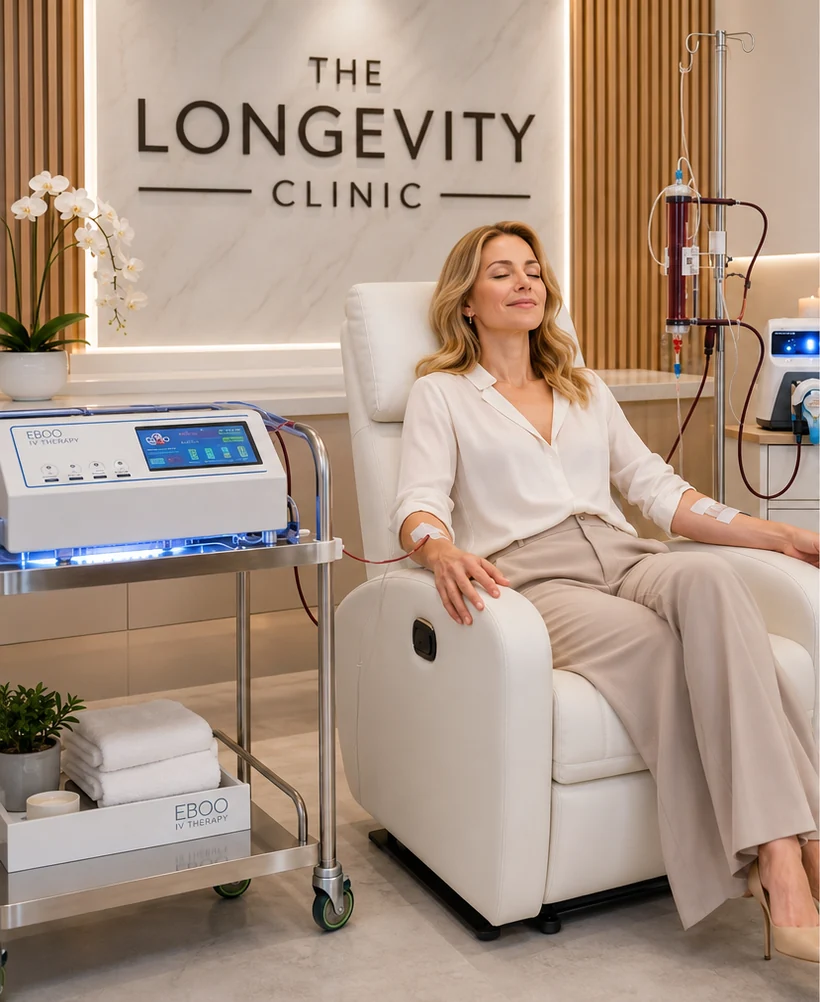
An hour to ninety minutes in a comfortable chair with a line in each arm. Most people read, work or sleep through it.
- Two IV lines are placed, one in each arm — one to draw, one to return. This is the only genuinely uncomfortable part and it takes a couple of minutes.
- The circuit starts and blood begins to flow. You will see it moving through the tubing, and the colour change as it oxygenates is quite striking. Many people find this the most interesting part.
- You sit for 60 to 90 minutes. There is no pain. Some people notice a mild metallic taste or slight lightheadedness early on, which settles.
- The lines come out and you go. Hydrate well. Some people feel energised the same day; others feel tired that evening and noticeably better the next morning. Both are normal.
How many sessions, and what it costs
The original clinical protocol ran fourteen sessions over seven weeks. In practice most people start with six to ten.
- Heavy inflammatory or infectious load: eight to twelve sessions, weekly, with labs rechecked partway through.
- Post-viral or general reset: six to eight sessions, weekly or fortnightly.
- Maintenance: monthly or quarterly once the initial course is done.
- Cost: EBOO generally runs about $350 to $900 per session in this market, with course pricing lowering the effective rate. It costs more than standard ozone IV because of the disposable filter set and the clinical time involved.
A single session will tell you how you tolerate it. It will rarely tell you what the therapy can do.
Getting EBOO ozone therapy near Nashville
EBOO requires equipment, disposables and training that most wellness clinics do not have, so it is far less available than standard ozone IV therapy.
Around Middle Tennessee you will find ozone therapy in several forms — rectal and vaginal insufflation, ozonated saline, MAH and 10-pass at a handful of integrative clinics. Full EBOO with filtration is a much shorter list.
We perform EBOO at 329 S. Royal Oaks Blvd, Franklin, Tennessee 37064, about twenty minutes south of downtown Nashville and minutes from Cool Springs and Brentwood. It is performed by licensed clinical staff, never unsupervised, and never before we have seen your bloodwork.
Ozone is one of those therapies people either dismiss without reading anything, or oversell without qualification. I do not think either position survives contact with the actual literature.
What I have seen in clinic is that for the person with a heavy inflammatory or infectious load — the one who has done the diet, done the sleep, done the supplements and is still stuck — EBOO is very often the thing that finally moves the needle. Not on its own, and not instead of finding the root cause. But as a way of resetting a system that has been running hot for years, it is the single most powerful tool in this building, and the one I would want first if I were carrying that load myself.
Common questions about EBOO in Nashville and Franklin
What is EBOO ozone therapy?
EBOO stands for extracorporeal blood oxygenation and ozonation. Blood is drawn continuously from one arm, passed through a dialysis-style filter and an ozonation chamber, then returned through the other arm. It is the most thorough form of ozone blood therapy available: a single session processes up to 4,800 millilitres of blood, compared with roughly 200 millilitres in a standard ozone IV. It was developed in the late 1990s by Italian nephrologist Dr. Nicola Di Paolo working with Professor Velio Bocci.
Where can I get EBOO ozone therapy near Nashville?
The Longevity Club + Clinic performs EBOO at 329 S. Royal Oaks Blvd in Franklin, Tennessee — about twenty minutes south of downtown Nashville and convenient to Brentwood, Cool Springs and Spring Hill. EBOO requires equipment and training that most wellness clinics do not have, so it is far less widely available than standard ozone IV therapy.
What is the difference between EBOO, MAH and 10-pass ozone therapy?
Volume and continuity. Major autohemotherapy, or MAH, removes about 200 millilitres of blood, ozonates it in a bag and returns it. Ten-pass repeats that cycle roughly ten times under pressure, treating around 2,000 millilitres in total. EBOO runs a continuous circuit rather than batches, filtering and ozonating up to 4,800 millilitres in a single session while also removing debris through the filter.
Is ozone therapy widely used?
Very. Medical ozone has been used clinically for more than four decades and is regulated, taught and routinely practised in Italy, Germany, Spain, Russia and Cuba, with professional societies and published protocols behind it. In the United States it is provided by licensed physicians under the practice of medicine rather than as an FDA-approved therapy, which is why it belongs in a clinical setting with proper testing and oversight.
Is EBOO safe?
In trained hands, with a licensed practitioner and proper equipment, the safety record is good — published reviews put the incidence of adverse events from medical ozone at well under one in ten thousand treatments. At the same time, this is an intravenous procedure with two lines and an extracorporeal circuit, so it belongs in a clinical setting with medical oversight, never a spa. The most common experiences are mild fatigue afterwards and bruising at the access site.
Who should not have EBOO?
It is not appropriate in pregnancy, in G6PD deficiency, with active bleeding disorders or on certain anticoagulants, in hyperthyroidism, or during an active flare of a serious cardiac condition. We also defer it when iron status is unsettled — specifically when ferritin is low while transferrin saturation runs high — because free iron amplifies oxidative reactions. That is a bloodwork question, which is why we test before we treat.
How many EBOO sessions do you need?
The original clinical protocol ran fourteen sessions over seven weeks. In practice most people start with a course of six to ten sessions scheduled weekly or fortnightly, with the number depending on what we are addressing and what your follow-up labs show. Single sessions are available but a single session is rarely where the benefit lives.
What does EBOO cost near Nashville?
EBOO generally runs from around $350 to $900 per session depending on the clinic, with course pricing bringing the effective rate down. It is more expensive than standard ozone IV therapy because of the disposable filter set, the equipment and the clinical time involved. We quote the full course before anything is scheduled.
- Di Paolo N, Bocci V, Gaggiotti E. Extracorporeal blood oxygenation and ozonation: clinical and biological implications of ozone therapy. Redox Report. 2005. PMID 16156950
- Martínez-Sánchez G, Al-Dalain SM, Menéndez S, et al. Therapeutic efficacy of ozone in patients with diabetic foot. European Journal of Pharmacology. 2005;523(1-3):151–161. PMID 16198334
- Izadi M, et al. Effect of Ozone Therapy on Diabetes-related Foot Ulcer Outcomes: A Systematic Review and Meta-analysis. Current Pharmaceutical Design. 2024.
- León Fernández OS, Ajamieh HH, Berlanga J, et al. Ozone oxidative preconditioning: a protection against cellular damage by free radicals. Mediators of Inflammation. 2008.
- Observed Reduction in Urinary Toxin Excretion With Extracorporeal Blood Oxygenation and Ozonation (EBOO) Treatment: A Case Report. PMC12826612
This article is educational and reflects the published literature as of August 2026. Medical ozone is provided in the United States under the practice of medicine rather than as an FDA-approved therapy. Nothing here is a diagnosis or a treatment recommendation for any individual, and any decision about your care belongs in a conversation with a licensed practitioner who has seen your history and your labs.