

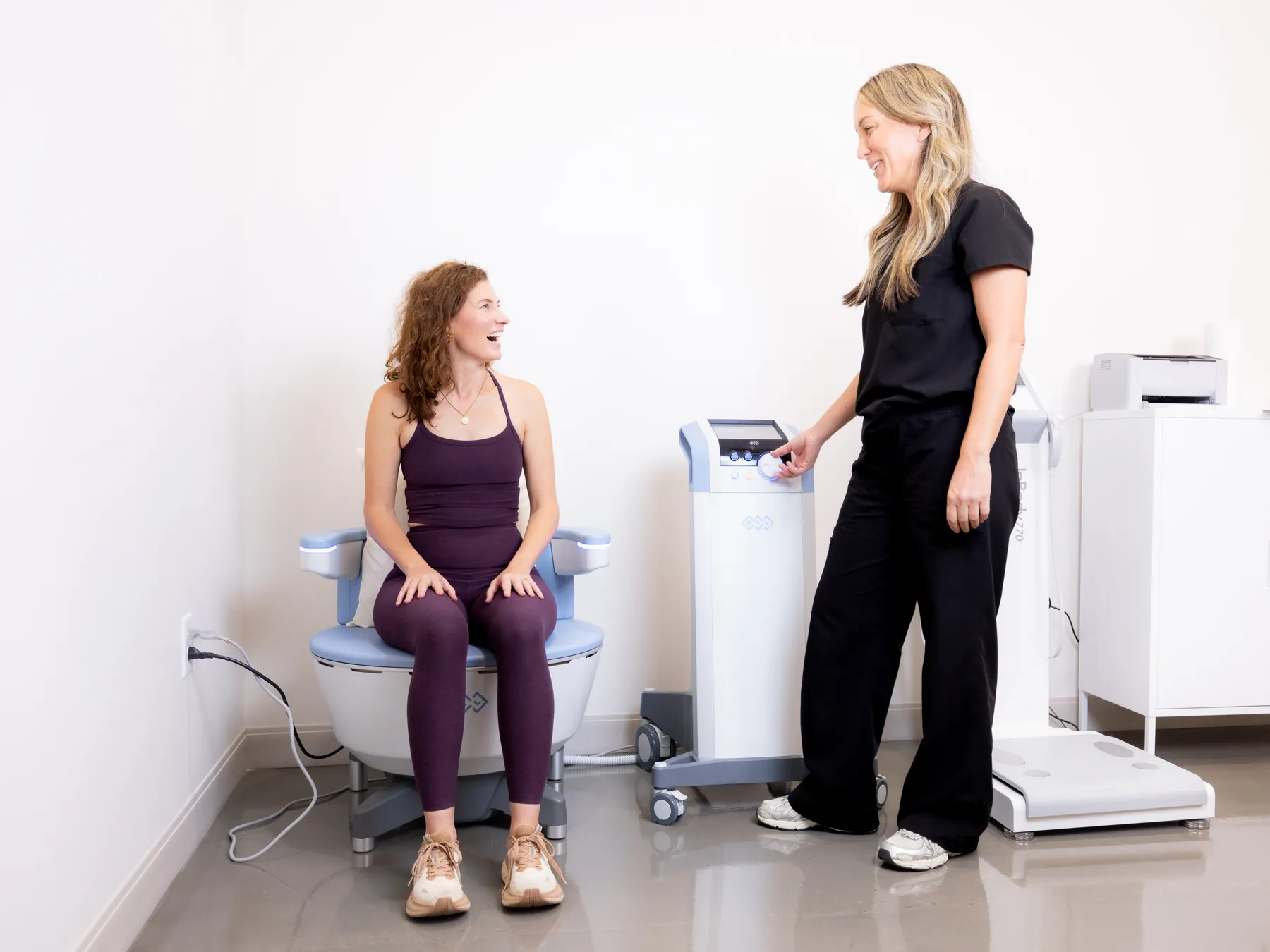
- You remain fully clothed and simply sit. Twenty-eight minutes, no undressing, no needles, no downtime, and you can read or work throughout.
- A single session produces thousands of pelvic floor contractions at an intensity you cannot achieve voluntarily — the equivalent of many thousands of Kegels.
- Most people cannot perform a Kegel correctly, and a substantial share actively bear down instead. This removes that problem entirely.
- Six sessions over three weeks is the standard course, twice weekly.
- It helps men too, particularly after prostate surgery, and men are dramatically under-represented among people seeking help for this.
What Emsella actually is
The technology is called high-intensity focused electromagnetic energy, and the simplest way to describe it is that it does the exercise for you, properly.
You sit, fully clothed, on what looks like an ordinary chair. It generates a focused electromagnetic field that stimulates the motor neurons supplying your pelvic floor, producing contractions at an intensity you cannot generate voluntarily — described in the literature as supramaximal.
Over a 28-minute session it produces thousands of these contractions. The comparison usually made is to many thousands of Kegel exercises, which is a fair way to convey the volume even if the contractions are qualitatively different.
Here is why that matters more than the number alone suggests. Research on pelvic floor exercise has repeatedly found that a large proportion of women cannot perform a Kegel correctly from verbal instruction, and a meaningful share actually bear down — doing the opposite of the intended movement. Emsella removes the technique problem entirely, because you are not performing the movement at all.
What you feel is a tingling and a pulling sensation, and the intensity is titrated to your comfort. It is not painful.
Why this works when Kegels have not
Who it helps
Broader than most people assume, and the group most under-represented is men.
Stress incontinence — leaking with coughing, sneezing, laughing, running or lifting. This is the classic indication and the one with the most evidence behind it.
Urge incontinence and overactive bladder — the sudden desperate need, sometimes with leaking before you arrive. Responds, though usually less completely than stress incontinence.
Postpartum recovery — and not only in the first year. Women who gave birth twenty years ago and have simply lived with it since respond as well as recent mothers.
Menopausal changes — falling estrogen affects the tissue of the pelvic floor and urethra directly, which is why this frequently begins or worsens in the forties and fifties.
Men after prostate surgery — incontinence following prostatectomy is common, distressing and dramatically under-treated. Men are also far less likely to seek help, which I would like to change.
Sexual function — pelvic floor strength affects sensation and function in both women and men, and this comes up frequently once patients feel able to raise it.
What the evidence shows
Emsella is FDA-cleared for the treatment of urinary incontinence, which is a meaningful distinction from many of the wellness devices in this field.
The trial evidence is reasonable for a device of its age. Published studies have reported substantial reductions in pad use, improvements in validated quality-of-life scores, and a majority of participants reporting meaningful improvement after a standard six-session course. Follow-up studies suggest benefit persists for months, with maintenance sessions extending it.
What I would add honestly: most published work has been on relatively small groups, and long-term data beyond a year is limited. The effect is real and well documented in the short and medium term; the question of how long it lasts without maintenance is still being answered.
The ten reasons patients come for Emsella
Ranked by how reliably each responds.
Stress Urinary Incontinence
The primary indication and the most reliable responder. Leaking with coughing, sneezing, laughing, lifting or running. This is what the FDA clearance covers and where the trial evidence is strongest.
What the evidence showsEmsella uses high-intensity focused electromagnetic technology to induce supramaximal pelvic floor contractions — thousands per session, at intensities not achievable voluntarily.Postpartum Pelvic Floor Weakness
Whether the birth was last year or twenty years ago. The pelvic floor does not spontaneously recover, and a great many women have simply accepted the consequences for decades without being offered anything.
What the evidence showsClinical studies of HIFEM for urinary incontinence have reported substantial reductions in pad use and improvements in quality of life scores, with benefit sustained at follow-up.Incontinence After Prostate Surgery
Common after prostatectomy, deeply distressing, and dramatically under-treated because men rarely raise it. Responds well, and I would encourage any man in this position to ask.
What the evidence showsPelvic floor muscle training has strong evidence for stress urinary incontinence, but adherence and correct technique are major limitations. HIFEM removes both variables.Overactive Bladder and Urge Incontinence
The sudden desperate need, and the constant awareness of where the nearest bathroom is. Responds, though generally less completely than stress incontinence, and often combined with other approaches.
What the evidence showsStress incontinence results from inadequate urethral support during increases in intra-abdominal pressure, and strengthening the supporting musculature addresses the mechanism directly.Menopausal Pelvic Floor Changes
Falling estrogen affects pelvic floor and urethral tissue directly. This is frequently when the problem begins, and addressing the hormonal picture alongside improves the result.
What the evidence showsUrge incontinence involves detrusor overactivity, and pelvic floor contraction produces reflex detrusor inhibition, which is why HIFEM has been studied in both incontinence types.Pelvic Floor Weakness Without Leaking
Heaviness, pressure, or a sense that something is not supported. Often precedes incontinence, and treating it at this stage is considerably easier than waiting.
What the evidence showsPostpartum pelvic floor dysfunction is common and under-treated, and HIFEM offers a non-invasive option that requires no undressing and no internal device.Sexual Function in Women
Pelvic floor strength affects sensation and function directly. This comes up frequently once patients feel able to raise it, and it improves alongside the primary indication.
What the evidence showsIn men, pelvic floor strengthening has evidence for post-prostatectomy incontinence and for erectile function through improved ischiocavernosus and bulbospongiosus function.Sexual Function in Men
Pelvic floor musculature is involved in erectile function and ejaculatory control. Less discussed than the female application and mechanistically just as relevant.
What the evidence showsSessions are typically 28 minutes with patients fully clothed and seated, and a standard course runs six sessions over three weeks.Post-Surgical Pelvic Recovery
After hysterectomy or other pelvic surgery, where the supporting musculature has been affected. Requires clearance from your surgeon on timing before starting.
What the evidence showsThere is no downtime, no anaesthesia and no recovery period, and the main contraindication is implanted metal or electronic devices in the treatment field.Athletes and Heavy Lifters
High-impact sport and heavy lifting place substantial demand on the pelvic floor, and leaking during training is far more common among female athletes than is ever discussed. It is not something to train through.
What the evidence showsBenefit is maintained with periodic maintenance sessions, and results are commonly reported to persist for six to twelve months after a completed course.What patients commonly experience under our care
When patients receive the proper guidance, here is what they commonly experience under our care.
- After the first session — awareness. Most people are surprised they can feel the contractions so distinctly, and it is often the first time someone has any clear sense of where their pelvic floor actually is.
- Sessions 2–3 — the first real change. Typically fewer leaking episodes and better control. Patients often notice they made it through a workout, a cough or a sneeze without incident, which is usually the moment they believe it is working.
- Sessions 4–6 — the substantive improvement. This is where most of the benefit lands. Published work reports substantial reductions in pad use and improvements in validated quality-of-life scores across a standard six-session course.
- Months 1–6 afterwards — how long it lasts. Benefit persists for months in the follow-up data, and maintenance sessions extend it. We plan that from the start rather than letting people drift back.
This is a problem an enormous number of people live with silently and assume is permanent, and it very often is not. Schedule a consultation and let my team assess your pelvic floor properly, look at the hormonal picture alongside it, and tell you honestly whether Emsella will help. You will be cared for with complete discretion by a team who take this as seriously as you do.
A proper assessment, complete discretion, and an honest answer about whether Emsella is the right option for you.
Common questions
Do you have to undress for Emsella?
No. You remain fully clothed throughout and simply sit on the chair for 28 minutes. There is no undressing, no examination during treatment, no needles and no downtime. Most patients read or work through the session.
How many Emsella sessions do I need?
Six sessions over three weeks, twice weekly, is the standard course. Most of the improvement accumulates across those six. Maintenance sessions afterwards extend the benefit, and we plan for that from the start rather than waiting for symptoms to return.
Does Emsella work for men?
Yes, and men are dramatically under-represented among people seeking help for this. It is particularly useful after prostate surgery, where incontinence is common and distressing. Pelvic floor musculature is also involved in erectile function and ejaculatory control.
What does Emsella feel like?
A tingling and a pulling sensation in the pelvic floor as the muscles contract. The intensity is titrated to your comfort and increased gradually across the session. It is not painful, and most patients describe it as strange at first and then unremarkable.
Who cannot have Emsella?
Anyone with a metal implant in the pelvic region, a pacemaker, defibrillator or other implanted electrical device, or a copper IUD. It is also not used during pregnancy. We screen for all of these before your first session.
- Samuels JB, Pezzella A, Berenholz J, Alinsod R. Safety and efficacy of a non-invasive high-intensity focused electromagnetic field device for treatment of urinary incontinence and enhancement of quality of life. Lasers in Surgery and Medicine. 2019;51(9):760–766.
- Silantyeva E, Zarkovic D, Astafeva E, et al. A comparative study on the effects of high-intensity focused electromagnetic technology and electrostimulation for the treatment of pelvic floor muscles and urinary incontinence in parous women. Female Pelvic Medicine & Reconstructive Surgery. 2021;27(4):269–273.
- Bo K, Hilde G. Does it work in the long term? A systematic review on pelvic floor muscle training for female stress urinary incontinence. Neurourology and Urodynamics. 2013;32(3):215–223.
- Bump RC, Hurt WG, Fantl JA, Wyman JF. Assessment of Kegel pelvic muscle exercise performance after brief verbal instruction. American Journal of Obstetrics and Gynecology. 1991;165(2):322–329.
This article is educational and reflects the published literature as of August 2026. It is not a diagnosis or a treatment recommendation for any individual, and any decision about your care belongs in a conversation with a licensed practitioner who has seen your history and your labs.