

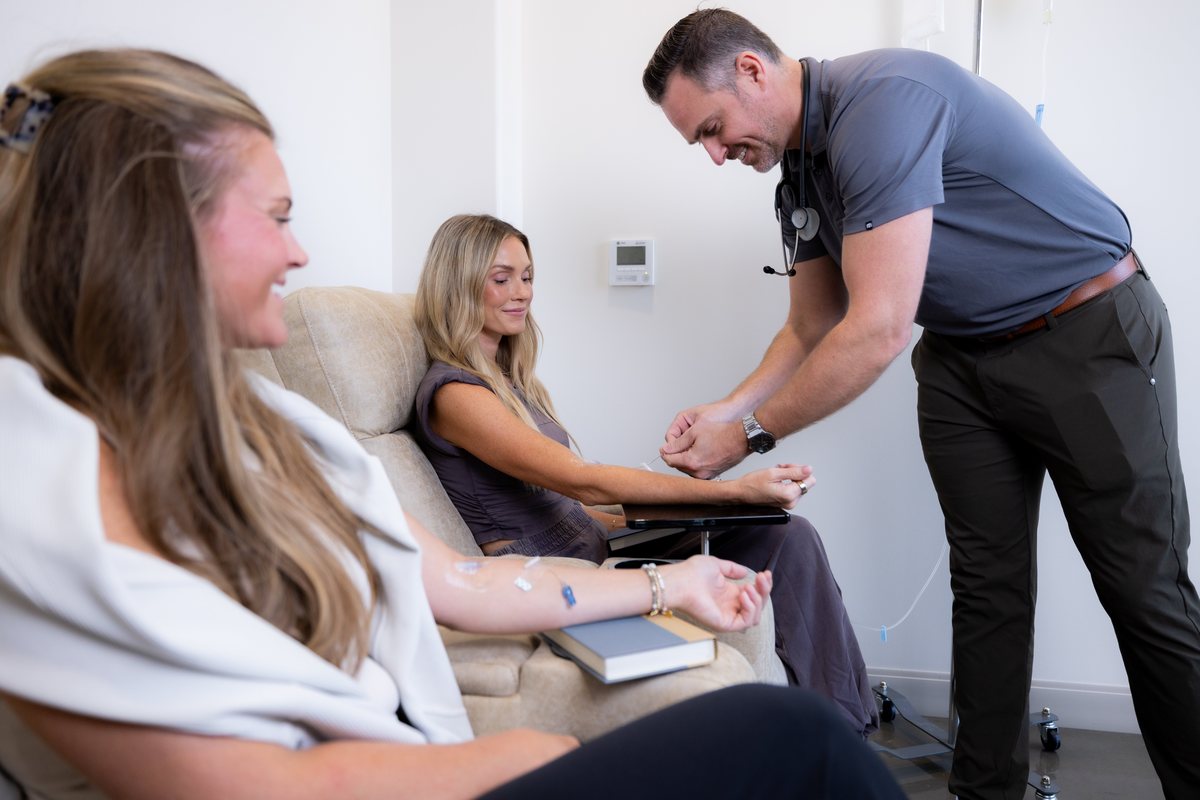
We deliver NAD+ support as Niagen IV — nicotinamide riboside, the precursor your body converts into NAD+, given intravenously — rather than as a straight NAD+ infusion. It raises the same coenzyme and is typically far better tolerated, without the chest tightness and flushing a fast NAD+ drip is known for. Everything below on how NAD+ works applies either way. See our IV therapy.
- NAD+ is required for the electron transport chain — the final step of turning food into ATP. Without it, energy production simply cannot proceed.
- It is also the fuel for your repair enzymes. Sirtuins and PARPs both consume NAD+ to do DNA repair and cellular housekeeping.
- Levels fall markedly with age, and DNA damage accelerates the decline because repair enzymes consume NAD+ to do their work.
- The infusion must run slowly — two to four hours. Pushed fast it produces chest tightness, nausea and a genuinely unpleasant session.
- The human evidence is earlier than the enthusiasm. The biochemistry is not in doubt; the clinical trial base is still developing, and we say so.
What NAD+ actually does
Nicotinamide adenine dinucleotide does two jobs, and both of them are foundational.
First, energy. NAD+ is the electron carrier at the heart of the electron transport chain. Every molecule of ATP your mitochondria produce depends on NAD+ cycling between its oxidised and reduced forms. It is not a supporting nutrient in energy production; it is a required participant at the centre of it.
Second, repair. Two families of enzymes consume NAD+ directly. Sirtuins regulate mitochondrial biogenesis, inflammatory signalling and a great deal of what we describe as cellular housekeeping. PARP enzymes perform DNA repair. Both spend NAD+ to do their jobs.
That creates a genuine tension. When DNA damage rises, PARP activity rises to repair it — and that consumes NAD+ that would otherwise be available for energy production and sirtuin activity. More damage means less NAD+ means less repair capacity. It is one of the more elegant and unforgiving loops in cellular biology.
Why levels fall, and what that costs
NAD+ declines substantially with age. The decline is not simply a marker of aging — it appears to be part of the mechanism.
Several things drive it. Production declines. Consumption rises as DNA damage accumulates and PARP activity increases. And CD38, an enzyme that degrades NAD+, increases with age and with chronic inflammation.
The downstream effect is what you would predict from the two jobs above: less efficient energy production, reduced sirtuin activity, slower DNA repair, and mitochondria that both function less well and are replaced less readily.
Which is why NAD+ has become central to the longevity conversation. It sits upstream of mitochondrial dysfunction, and mitochondrial dysfunction is one of the recognised hallmarks of aging.
Why intravenous, and why it has to run slowly
These are the two questions patients ask me most about NAD+, and both have specific answers.
Why not just take a capsule? NAD+ itself is a large molecule that is poorly absorbed intact from the gut. Oral supplementation generally uses precursors — nicotinamide riboside or nicotinamide mononucleotide — which the body then has to convert. Those are genuinely useful, and the research on them is developing well. Intravenous delivery bypasses both the absorption problem and the conversion step.
Why does it take three hours? Because a rapid infusion is genuinely unpleasant. Pushed quickly, NAD+ produces chest tightness, abdominal cramping, nausea and a sensation most people describe as intensely uncomfortable. Slowed down, those effects largely disappear. This is the therapy where rushing the appointment ruins the experience, and a forty-minute NAD+ drip is either a very small dose or an unpleasant appointment.
Doses typically run from 250 mg for a first session up to around 1,000 mg once tolerance is established. We start low deliberately.
The ten reasons people seek out NAD+
Ranked by how directly the mechanism applies and how consistently we see a response.
Energy and Mental Clarity
The most common reason and the most consistently reported effect. NAD+ is directly required for ATP production, and the brain is the most energy-demanding tissue you have. Patients describe clarity rather than stimulation — the distinction matters, and it is why this does not feel like caffeine.
What the evidence showsNAD+ is the obligate electron carrier at complex I of the electron transport chain. Covarrubias and colleagues reviewed its central role in cellular metabolism and ageing in Nature Reviews Molecular Cell Biology.Healthy Aging and Cellular Repair
The longevity case, and the reason NAD+ became well known. Sirtuins and PARPs both consume NAD+ to do repair work, so availability sets a ceiling on repair capacity. The biochemistry here is solid; the human longevity outcomes are still being established.
What the evidence showsSirtuins and PARP enzymes both consume NAD+ as substrate for DNA repair and cellular housekeeping. Rising DNA damage increases PARP activity, depleting NAD+ available for energy production.Post-Viral and Chronic Fatigue
Where the timeline starts with an illness and energy never returned, mitochondrial dysfunction is often central. NAD+ addresses that directly rather than working around it, and this is one of the groups reporting the clearest subjective response.
What the evidence showsPost-viral syndromes show documented mitochondrial dysfunction. NAD+ availability directly constrains electron transport chain throughput, making it a mechanistically direct target rather than a supportive one.Cognitive Support and Brain Fog
Neurons are metabolically expensive and intolerant of energy shortfalls. NAD+ crosses into the relevant compartments and supports both mitochondrial output and the repair enzymes protecting neural tissue. Research here is active and genuinely promising.
What the evidence showsThe brain accounts for approximately 20 percent of resting energy expenditure. NAD+ precursor research in neurodegeneration and cognitive ageing is active, with Verdin reviewing the neurological evidence in Science.Addiction Recovery Support
NAD+ has been used in this setting for decades, most commonly in extended high-dose protocols, with reports of reduced withdrawal severity and cravings. The clinical literature is thinner than the practice, and this belongs firmly within a proper recovery programme rather than instead of one.
What the evidence showsNAD+ infusion protocols in addiction settings have decades of clinical use with reports of reduced withdrawal severity and craving, though the controlled trial literature remains limited relative to clinical practice.Athletic Performance and Recovery
Training capacity is limited by mitochondrial output, and hard training raises the DNA repair demand that consumes NAD+. Athletes report faster recovery between hard sessions, though controlled performance data remains limited.
What the evidence showsTraining capacity is constrained by mitochondrial ATP output, and intensive exercise raises DNA repair demand that consumes NAD+. Rajman and colleagues reviewed the in vivo evidence for NAD-boosting molecules in Cell Metabolism.Metabolic Support
Sirtuin activity influences insulin sensitivity and mitochondrial biogenesis, and NAD+ availability governs sirtuin activity. This is mechanistically coherent and one of the more active areas in the research.
What the evidence showsSirtuin activity regulates mitochondrial biogenesis through PGC-1alpha and influences insulin sensitivity. Sirtuin function is directly limited by NAD+ availability.Sleep and Circadian Rhythm
NAD+ levels themselves oscillate on a circadian cycle, and sirtuins are directly involved in clock regulation. Patients frequently report improved sleep quality, which is likely both a direct effect and a consequence of better daytime energy.
What the evidence showsNAD+ levels oscillate on a circadian cycle, and SIRT1 participates in molecular clock regulation through interaction with CLOCK-BMAL1, creating bidirectional coupling between metabolism and circadian timing.Alongside Other Therapies
NAD+ pairs well with other therapies that act on mitochondrial function through different routes — red light being the one we offer. Where energy is the target, they tend to appear together.
What the evidence showsHyperbaric oxygen, photobiomodulation and NAD+ each act on mitochondrial function through distinct mechanisms — oxygen availability, cytochrome c oxidase activation and electron carrier supply respectively.Immune and Inflammatory Support
CD38, the enzyme that degrades NAD+, rises with chronic inflammation — so inflammation and NAD+ depletion feed each other. Addressing the inflammatory driver alongside the infusion matters more here than the infusion alone.
What the evidence showsCD38 is the principal NAD+-consuming enzyme and its expression increases with age and inflammation. Camacho-Pereira and colleagues demonstrated CD38 drives age-related NAD+ decline in Cell Metabolism.What people commonly experience with NAD+ therapy
With the right guidance, here is what people commonly experience.
- During and immediately after — clarity. Many patients describe mental clarity before the bag is finished. This is the most consistently reported immediate effect, and it is clarity rather than stimulation.
- The following days — energy that holds. Not a lift and a crash. Patients describe capacity through a full day, which is what you would expect from improved ATP production rather than adrenergic stimulation.
- Across three to six sessions — sleep and recovery. Sleep quality typically improves through this window, and training recovery shortens. This is where a course begins to separate from a single session.
- Across a full course — the durable change. Sustained energy, better cognitive endurance and improved recovery capacity. Objective measures matter here, because a therapy at this price should be accountable to something more than how a session felt.
If your energy has been gone for long enough that you have stopped expecting it back, let us find out why. Schedule a consultation and my team will look for the root cause first, then tell you honestly whether NAD+ is the right lever for you. You deserve care from people who investigate before they infuse.
We will look at what is actually driving your fatigue first, and tell you honestly whether this is the therapy that addresses it.
Common questions
What does NAD+ IV therapy do?
NAD+ is a coenzyme required for the electron transport chain, which is how your mitochondria produce ATP, and it is also consumed by the sirtuin and PARP enzymes that perform DNA repair and cellular housekeeping. Infusing it raises availability for both jobs. Patients most commonly report mental clarity and sustained energy.
How long does an NAD+ IV take?
Two to four hours, and that is deliberate. Infused rapidly, NAD+ causes chest tightness, cramping and nausea. Slowed down, those effects largely disappear. Any clinic offering a forty-minute NAD+ infusion is either using a very small dose or making the experience unpleasant.
Is NAD+ IV better than NMN or NR supplements?
They do different things. Oral NMN and NR are precursors your body converts into NAD+, and the research on them is developing well. Intravenous NAD+ bypasses both absorption and conversion, achieving levels oral dosing cannot. Many patients use infusions periodically and an oral precursor daily.
How much does NAD+ IV therapy cost near Nashville?
NAD+ infusions typically run higher than standard nutrient IVs because of both dose and chair time — generally $400 to $800 per session in this market depending on dose, with package pricing lowering the effective rate.
How many NAD+ sessions do I need?
It depends entirely on the goal. For general energy and longevity support, a series of four to six sessions followed by monthly maintenance is typical. For post-viral fatigue or more intensive protocols, higher frequency over a shorter period is more common. We would rather build that around your case than sell a fixed package.
Are there side effects?
During infusion, the common experiences are chest tightness, flushing, cramping or nausea if the rate is too fast — all of which resolve by slowing the drip. Afterwards, most people feel fine or pleasantly tired. It is not appropriate in pregnancy, and anyone with significant cardiac or kidney disease needs review first.
- Covarrubias AJ, Perrone R, Grozio A, Verdin E. NAD+ metabolism and its roles in cellular processes during ageing. Nature Reviews Molecular Cell Biology. 2021;22(2):119–141. PMC7963035
- Rajman L, Chwalek K, Sinclair DA. Therapeutic potential of NAD-boosting molecules: the in vivo evidence. Cell Metabolism. 2018;27(3):529–547. PMC6342515
- Camacho-Pereira J, et al. CD38 dictates age-related NAD decline and mitochondrial dysfunction. Cell Metabolism. 2016;23(6):1127–1139.
- Verdin E. NAD+ in aging, metabolism, and neurodegeneration. Science. 2015;350(6265):1208–1213.
This article is educational and reflects the published literature as of August 2026. It is not a diagnosis or a treatment recommendation for any individual, and any decision about your care belongs in a conversation with a licensed practitioner who has seen your history and your labs.