

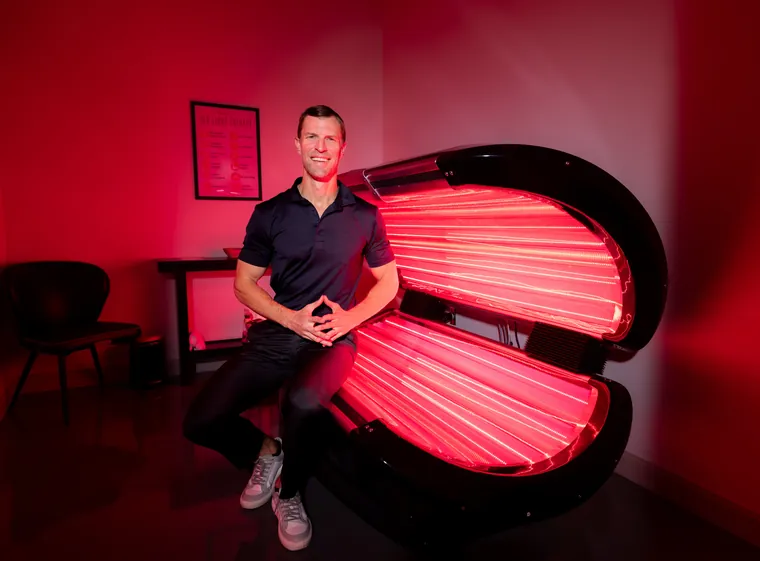
- Light is a nutrient your cells actually use. Red and near-infrared wavelengths are absorbed by an enzyme inside your mitochondria, and the result is more ATP and less oxidative stress.
- Wavelength decides depth. Blue works on the skin surface, red in the collagen layer, near-infrared down into muscle and joint. A two-wavelength device cannot reach everything.
- Power matters as much as colour. Our Summus Vita bed runs five wavelengths at 3,325 watts across your whole body — a different category from a home panel.
- Frequency beats intensity. Two to four sessions a week for six to eight weeks, then maintenance. More light in one sitting is not better.
- Almost nobody cannot do this. No UV, no downtime, twelve to twenty minutes, and you walk straight back into your day.
What red light therapy actually is
Red light therapy — photobiomodulation, or PBM, in the literature — is the use of specific wavelengths of red and near-infrared light to change how your cells behave. It is not heat, it is not ultraviolet, and it is not a tanning bed. It is light as a signal.
Here is the part that convinced me. Inside every one of your cells sit mitochondria, and at the end of the mitochondrial electron transport chain sits an enzyme called cytochrome c oxidase. That enzyme has light absorption peaks right around 660 and 810 nanometres. It is, quite literally, built to absorb this light.
When it does, three things follow. Nitric oxide that had been sitting in the way is released, which unblocks the chain and improves local blood flow. ATP production rises — your cells make more energy. And a brief, mild burst of signalling molecules switches on the cell's own repair and antioxidant machinery.
That is the whole thing. You are not adding a drug. You are giving a cell that has been running at seventy percent the conditions to run at ninety. Which is why one therapy shows up in research on skin, joints, muscle, mood, hair and brain — those are all just tissues made of cells with mitochondria in them.
I have spent twenty years looking for interventions that are powerful, genuinely safe and simple enough that people actually do them. Very few clear all three bars. Red light therapy does. There is no recovery time, no needle, no drug interaction list to worry through, and the session is twelve to twenty minutes of lying still. When something with this much research behind it is also this easy to be consistent with, that is a rare combination.
How deep each wavelength actually reaches
This is the question that separates a useful device from an expensive light. Different wavelengths stop at different depths, which means the wavelengths a device offers determine which tissues it can actually treat.
Two honest notes on those numbers. First, published depth figures vary widely because they depend on skin tone, body fat, hydration and tissue type — what stays consistent is the ordering. Near-infrared always goes deeper than red, and red always goes deeper than blue.
Second, and more importantly: wavelength alone is not enough. A device can advertise 850nm and still fail to deliver a useful dose two centimetres down, because what reaches the target depends on how much power hit the skin in the first place. This is the single biggest difference between a home panel and a clinical bed, and it is almost never discussed.
The bed we use, and why it matters
We use the Summus Vita full-body light therapy bed. It is the reason we can say we do photobiomodulation rather than red light.
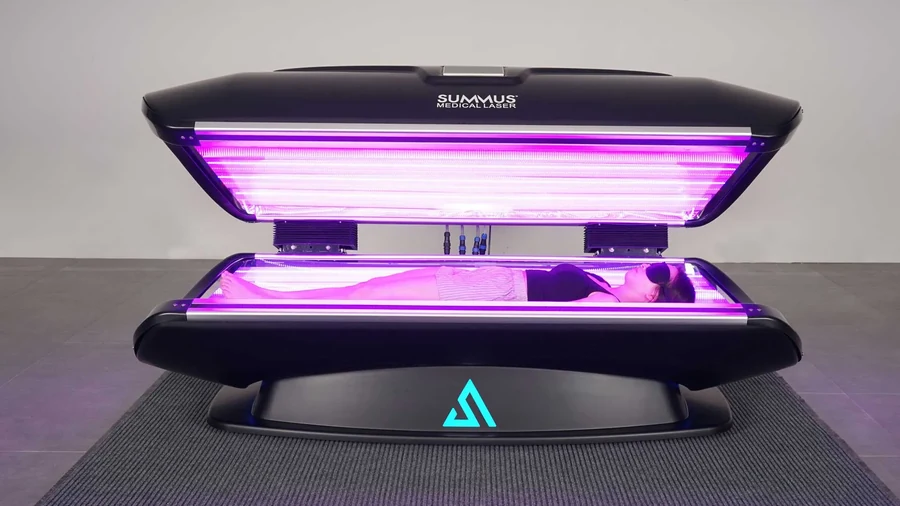
Most red light devices — including most beds in studios around Nashville — run two wavelengths, typically 660nm and 850nm. Those are good, well-researched wavelengths. But they cover the skin and the deep tissue while skipping what sits between and beyond.
The Vita bed delivers five wavelengths simultaneously — 450, 650, 810, 850 and 980nm — at 3,325 watts across your entire body, with each wavelength independently controllable.
That last detail is what makes it a clinical instrument rather than a light: a skin protocol and a recovery protocol are not the same recipe, and a bed that only does one thing cannot deliver both.
The 450nm blue wavelength is unusual on a full-body bed and it is genuinely useful for skin. The 980nm wavelength is absorbed by water rather than by cytochrome c oxidase, which produces the pleasant warmth you feel and a real increase in local circulation. Together with the three core PBM wavelengths, you are treating the surface, the collagen layer, the deep tissue and the circulation in one twenty-minute session.
How much stronger is this than a home panel?
This is the fairest question people ask, and the answer is bigger than most expect. A good consumer panel is a genuinely useful thing — I am not dismissing them. But it is a different category of device, and the gap is measurable rather than a matter of opinion.
So on raw output the bed runs roughly ten to thirty times a typical home panel — and that is before you account for coverage. A panel lights one surface of one body region at a time; the bed surrounds you from above and below. And because dose at depth depends on how much power reaches the skin, that output difference is precisely what determines whether 850nm light actually arrives at a joint two centimetres down or simply warms the surface.
The practical version: a home panel is excellent for a face, a shoulder or a knee, and for daily consistency. A clinical bed is what you use when you want the whole body treated at a dose the research was run at.
Full-body photobiomodulation in Franklin, twenty minutes from downtown Nashville. Your discovery call is free and we will build the protocol around what you are actually trying to change.
Top 10 red light therapy benefits
Ranked from the most established to the most exciting, with what the research actually supports for each.
Skin, Collagen & Visible Aging
This is the most studied use and the one people notice first in the mirror. Red light around 650nm is absorbed in the dermis, where fibroblasts respond by producing more collagen and elastin. In a split-face randomised trial of 137 women, ten sessions of red photobiomodulation over four weeks reduced periocular wrinkle volume by roughly 30 percent — measured, not self-reported. Skin tone evens out, pores tighten, and post-procedure recovery speeds up.
What the evidence showsIn a split-face randomised controlled trial of 137 women, ten sessions of red photobiomodulation across four weeks reduced periocular wrinkle volume by approximately 30 percent measured instrumentally rather than by self-report.Pain, Arthritis & Inflammation
Photobiomodulation has one of the deepest evidence bases in all of pain medicine, and it is the reason light therapy sits in physiotherapy clinics worldwide. An umbrella review of meta-analyses published in 2025 found consistent benefit for pain intensity across a range of musculoskeletal conditions, and the near-infrared wavelengths reach the joint capsule where the trouble actually is. Knees, shoulders, low back, plantar fascia and neck all respond.
What the evidence showsAn umbrella review of meta-analyses published in 2025 found consistent benefit for pain intensity across a range of musculoskeletal conditions. Near-infrared wavelengths at 810 to 850nm penetrate to the joint capsule.Muscle Recovery & Athletic Performance
If you train hard, this is the most reliable return on twenty minutes you will find. A 2025 meta-analysis of fourteen controlled studies found photobiomodulation meaningfully reduced delayed-onset muscle soreness, and earlier work showed reduced markers of exercise-induced muscle damage and improved performance when light was applied before training. Elite teams have used this for years. Applied whole-body, it works on every muscle group at once.
What the evidence showsA 2025 meta-analysis of fourteen controlled studies found photobiomodulation significantly reduced delayed-onset muscle soreness. Earlier work documented reduced creatine kinase and improved performance when light was applied before training.Wound Healing & Tissue Repair
Light drives the same repair machinery whether the tissue is a surgical incision, a stubborn wound or a strained tendon: more ATP, more fibroblast activity, more new capillary growth, less inflammatory drag. This is where photobiomodulation started clinically and it remains one of its most dependable applications. Used before and after a planned procedure, it gives the tissue a genuine head start.
What the evidence showsPhotobiomodulation increases ATP production, fibroblast proliferation and angiogenesis in wound models, and it is among the earliest and most consistently reproduced clinical applications of the technology.Mood, Sleep & Circadian Rhythm
A 2025 systematic review and meta-analysis of randomised trials found photobiomodulation improved depression symptoms, and sleep quality improved alongside it. Part of that is mitochondrial — the brain is the most energy-hungry organ you have. Part of it is simply that bright therapeutic light in the morning anchors a circadian rhythm that modern indoor life has flattened. Patients report the sleep change first, often within two weeks.
What the evidence showsA 2025 systematic review and meta-analysis of randomised controlled trials found photobiomodulation improved depression symptoms. Morning bright light exposure independently anchors circadian rhythm and supports normal cortisol and melatonin timing.Brain, Focus & Cognitive Support
The 810nm wavelength is the one used in most transcranial photobiomodulation research, because it matches the absorption peak of cytochrome c oxidase in its reduced state and penetrates well enough to reach cortical tissue. Trials in traumatic brain injury, cognitive decline and mood have been promising, and this is one of the most active areas in the field right now. Early, but genuinely exciting.
What the evidence showsThe 810nm wavelength matches the absorption peak of cytochrome c oxidase in its oxidised state and penetrates sufficiently to reach cortical tissue. Transcranial photobiomodulation trials in traumatic brain injury and cognitive decline have reported measurable improvements.Hair Growth & Density
Low-level light therapy for androgenetic hair loss is FDA-cleared and supported by multiple randomised trials showing increased hair count and density in both men and women. It works by extending the growth phase of the follicle and improving blood flow to the scalp. It is not dramatic, and it is not fast, but it is one of the few non-pharmaceutical options with real trial support behind it.
What the evidence showsLow-level light therapy for androgenetic alopecia is FDA-cleared, supported by multiple randomised controlled trials showing increased hair count and density in both men and women.Thyroid & Autoimmune Support
This one deserves more attention than it gets. Randomised work from Brazil applied near-infrared photobiomodulation over the thyroid in patients with autoimmune thyroiditis and reported reduced levothyroxine requirements, lower antibody levels and improved gland vascularisation, with benefits persisting at long-term follow-up. It does not replace thyroid medication or proper testing — but for a gland sitting one centimetre below the skin, the mechanism is entirely plausible.
What the evidence showsRandomised work from Brazil applying near-infrared photobiomodulation over the thyroid in autoimmune thyroiditis reported reduced levothyroxine requirements, lower antibody levels and improved gland vascularisation, with benefits persisting at long-term follow-up.Circulation & Metabolic Support
Near-infrared light triggers release of nitric oxide from the cell, which relaxes vessel walls and improves local blood flow — you can often feel this as warmth during a session. Better perfusion means better nutrient delivery and better waste clearance, which is upstream of nearly everything else on this list. The research on body composition specifically is still early, and I would treat those claims with caution.
What the evidence showsNear-infrared light triggers nitric oxide release from cytochrome c oxidase, producing local vasodilation and improved perfusion — measurable as increased local blood flow during and after treatment.Mitochondrial Health & Longevity
This is the mechanism underneath all nine of the above, and the reason I care about it most. Cytochrome c oxidase is the final enzyme in the electron transport chain, and it absorbs red and near-infrared light directly. Give it that light and ATP production rises while oxidative stress falls. Mitochondrial decline is one of the central hallmarks of aging — and this is one of the very few interventions that speaks to mitochondria in their own language.
What the evidence showsCytochrome c oxidase is the terminal enzyme of the mitochondrial electron transport chain and absorbs red and near-infrared light directly. Photon absorption increases ATP output while reducing oxidative stress, an unusual combination.Red light therapy is a genuine amplifier — it makes your body better at the repair it is already trying to do. What it is not is a replacement for sleep, protein, movement or fixing a deficiency we can measure in your blood. Use it on top of good foundations and it is remarkable. Use it instead of them and you will be disappointed.
What patients commonly experience under our care
When patients receive the proper guidance, here is what they commonly experience under our care.
- Sessions 1–3 — recovery and soreness. Near-infrared light triggers nitric oxide release from the mitochondrial enzyme it binds to, which relaxes vessel walls and improves local perfusion. More blood into a worked muscle means faster clearance of the metabolites that make it ache. This is the fastest effect and the one athletes notice first.
- Weeks 1–2 — sleep and mood. Two things are happening together. Bright therapeutic light early in the day anchors a circadian rhythm that indoor life has flattened, which supports a normal cortisol curve and therefore normal melatonin release at night. Meanwhile the brain, being the most energy-hungry organ you have, benefits directly from improved mitochondrial output.
- Weeks 4–8 — skin and joints. Fibroblasts in the dermis respond to red light by producing more collagen and elastin, but collagen turnover is slow by design. This is why the facial rejuvenation trials measure at four to twelve weeks, and why patients who judge it at week two conclude too early.
- Weeks 8–12 — the measurable window. This is where the published outcomes sit: reduced wrinkle depth and volume, improved skin texture and tone, meaningful reduction in joint pain scores. It is also where most people stop thinking of it as a treatment and start thinking of it as part of the week.
If you want to feel and look better without adding another prescription, this is one of the easiest places to start. Schedule a consultation and my team will build the rhythm around the result you actually want — after we have looked at what is driving things underneath. Care from people who measure rather than guess.
The pattern to understand is that red light rewards frequency, not intensity. The patient who comes three times a week for two months gets a different result from the patient who comes twice and concludes it did nothing.
How often to go, and for how long
Photobiomodulation follows what researchers call a biphasic dose response, which is a technical way of saying that the right amount helps and far more than that does not help more. Frequency is what drives results.
- Weeks 1–8: two to four sessions a week. This is the loading phase and it is where the change happens.
- Maintenance: one to two sessions a week, indefinitely. The benefits are cumulative and they fade if you stop.
- Recovery and performance: before training for output, after training for soreness. Both are supported.
- Skin goals: plan on eight to twelve weeks before you judge it. Collagen turns over slowly, which is why the trials measure at four to twelve weeks.
- Sleep and mood: morning or early afternoon sessions, and expect the first signal within two weeks.
What a session is actually like
Twelve to twenty minutes, lying down, in warmth. Most people describe it as the most relaxing part of their week.
- You undress to your comfort level. More skin exposed means more surface receiving light, so most people go down to underwear. Nothing between the light and the tissue you want treated.
- You lie in the bed and it closes over you. It does not touch you and it is not enclosed like an MRI. Eye protection is provided.
- The light comes on and it feels warm. Not hot — warm, like sun through a window. Many people fall asleep.
- You get up and carry on with your day. No downtime, no recovery, no marks. Drink water afterwards and go.
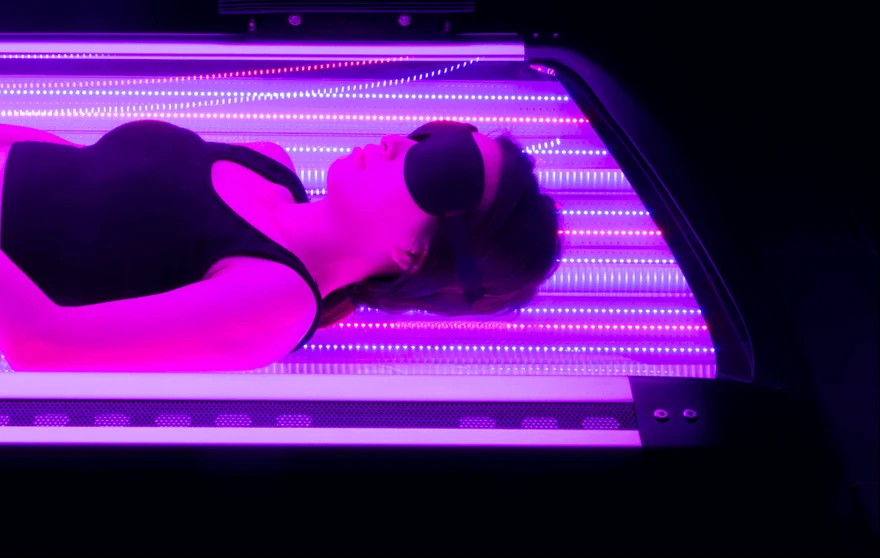
No prep, no fasting, no recovery time. Come as you are, and go straight back to your day afterwards.
Safety, and the few people who should wait
Photobiomodulation has one of the cleanest safety profiles of any therapy we offer. No ultraviolet, no ionising radiation, no needles, no downtime.
What people occasionally notice: mild warmth during the session, and very occasionally a brief headache or a feeling of being wired if they overdo the frequency early. Both settle by dialling the dose back.
Worth reviewing before you start: photosensitising medications, which include some antibiotics such as doxycycline, certain diuretics, isotretinoin, some antipsychotics and St John's wort. Eye protection is used throughout. If you have a history of seizure disorder we avoid pulsed settings. If you are pregnant, or have an active malignancy, that is a conversation to have with your clinician before booking rather than after.
For everyone else — which is nearly everyone — this is about as low-risk as an effective therapy gets.
What red light therapy costs near Nashville
Full-body sessions across Nashville, Franklin and Brentwood generally run about $60 to $120 depending on the device, the number of wavelengths and whether there is clinical oversight, with memberships and packages bringing the effective rate well below that.
Because results are driven by frequency rather than by any single session, the sensible way to think about cost is monthly. A protocol of two to four sessions a week for eight weeks is what the research supports, and any clinic worth using should quote you that whole figure up front rather than selling you sessions one at a time.
For our members, red light is included in the monthly programme rather than billed per visit — which is deliberate, because the therapy only works if you actually come.
Getting red light therapy near Nashville
Middle Tennessee has plenty of options now, and they are not equivalent. The right one depends on what you are trying to change.
- Studios and gyms around Brentwood and Nashville offer membership-based red light, usually on two-wavelength beds. Convenient and affordable for general recovery.
- Med-spas typically focus on the skin applications and often use panels or beds optimised for the red range.
- Physician-led clinics like ours run higher-output multi-wavelength systems with a protocol built around your goals — and, in our case, around what your bloodwork shows.
We are at 329 S. Royal Oaks Blvd, Franklin, Tennessee 37064 — about twenty minutes south of downtown Nashville, minutes from Cool Springs and Brentwood, and easy from Spring Hill, Murfreesboro and across Williamson County.
Of everything we offer, red light is the therapy I recommend to the widest range of people — because there is almost nobody it is wrong for, and because it compounds. The person who comes three times a week for two months gets a completely different result from the person who comes twice and decides it did not do much.
God designed our bodies to run on light. We evolved outdoors, and most of us now spend our days under bulbs that emit almost none of the spectrum our mitochondria are built to use. Twenty minutes in a proper light bed is not exotic. In a sense it is just giving your cells back something modern life quietly took away.
Common questions about red light therapy in Nashville and Franklin
Where can I get full-body red light therapy near Nashville?
The Longevity Club + Clinic offers medical-grade full-body photobiomodulation at 329 S. Royal Oaks Blvd in Franklin, Tennessee — about twenty minutes south of downtown Nashville and minutes from Brentwood, Cool Springs and Spring Hill. We use the Summus Vita bed, which delivers five wavelengths at 3,325 watts across your whole body at once. Several studios and med-spas around Nashville and Brentwood also offer red light beds, most commonly two-wavelength systems.
What is the difference between red light therapy and photobiomodulation?
They describe the same thing. Photobiomodulation, or PBM, is the clinical term for using red and near-infrared light to stimulate cellular activity, and it is what you will find in the published literature. Red light therapy is the everyday name for it. Low-level laser therapy and LLLT are older terms for the same mechanism delivered by laser rather than LED.
How deep does red light therapy actually penetrate?
It depends on the wavelength and on how much power reaches your skin. Blue light at 450nm stays at the surface, under a millimetre. Red at around 650nm works mainly in the dermis, roughly one to three millimetres, which is where collagen and fibroblasts live. Near-infrared at 810 to 850nm is the deep worker, reaching muscle, tendon and joint at around two to three centimetres when surface irradiance is high enough. Depth claims of many inches are marketing rather than physics.
How often should you do red light therapy?
For most goals, two to four sessions a week for the first six to eight weeks, then a maintenance rhythm of one to two sessions weekly. Photobiomodulation follows a biphasic dose response, which means more is not better past a point — too much light in one sitting can blunt the effect rather than amplify it. Consistency beats intensity.
How long before you see results from red light therapy?
Recovery and pain responses are often noticed within one to three sessions. Sleep and energy changes commonly appear in the first two weeks. Skin changes follow collagen turnover, so most trials measure at four to twelve weeks — the facial rejuvenation trials that reported meaningful wrinkle reduction ran ten sessions across four weeks.
Is red light therapy safe?
It has an excellent safety record. There is no ultraviolet light, no ionising radiation and no downtime. The most common experience is mild warmth. Eye protection is used for the blue and near-infrared wavelengths, and we review photosensitising medications such as doxycycline, certain diuretics and St John's wort before your first session. If you are pregnant or have an active malignancy, that belongs in a conversation with your clinician first.
What does red light therapy cost in the Nashville area?
Single full-body sessions around Nashville, Franklin and Brentwood generally run about $60 to $120, with memberships and clinic packages bringing the effective cost well below that. Because results build with frequency, the sensible way to price it is per month rather than per session.
Does red light therapy help thyroid function?
There is a small but genuinely interesting body of research here. Randomised work from Brazil applied near-infrared photobiomodulation over the thyroid in patients with autoimmune thyroiditis and reported reduced levothyroxine requirements and lower antibody levels, with benefits still present at follow-up years later. It is not a replacement for thyroid medication or for proper testing, but it is one of the reasons we look at the full thyroid panel before building a protocol.
- Effects of photobiomodulation on multiple health outcomes: an umbrella review of randomized clinical trials. Systematic Reviews. 2025. PMC12326686
- Photobiomodulation Reduces Periocular Wrinkle Volume by 30%: A Randomized Controlled Trial. Photobiomodulation, Photomedicine and Laser Surgery. 2023. PMID 36780572
- Effects of Photomodulation Therapy for Delayed Onset Muscle Soreness: A Systematic Review and Meta-Analysis. 2025. PMC12286287
- Photobiomodulation improves depression symptoms: a systematic review and meta-analysis of randomized controlled trials. Frontiers in Psychiatry. 2025. PMC12457395
- Bjordal JM, et al. A systematic review of low level laser therapy with location-specific doses for pain from chronic joint disorders. Australian Journal of Physiotherapy. 2003. PMID 12580887
- Ferraresi C, et al. Effects of low level laser therapy on muscle performance and exercise-induced damage. 2012. PMID 22988275
- Bragato E, et al. Role of photobiomodulation application frequency in facial rejuvenation: randomized, sham-controlled, double-blind clinical trial. Lasers in Medical Science. 2025. doi:10.1007/s10103-025-04383-1
This article is educational and reflects the published literature as of August 2026. It is not a diagnosis or a treatment recommendation for any individual. The Summus Vita bed is cleared for topical heating and the temporary relief of minor muscle and joint pain, arthritis and muscle spasm; other applications described here are supported by research but fall outside that clearance.