

- Cartilage is avascular. It has no blood supply, and receives nutrients only through compression and release as you move. That is why immobility makes joints worse.
- Osteoarthritis is not simply wear and tear. Inflammatory signalling is actively involved, which is why it responds to metabolic and dietary work at all.
- Anti-inflammatories reduce the signal without changing the cause, and long-term NSAID use has its own real costs to the gut, kidney and cartilage itself.
- Muscle is the joint's suspension. Strengthening what surrounds a joint reduces the load through it more reliably than anything you can take.
- Regenerative options exist between doing nothing and surgery — and most patients are never told about the middle ground.
Why cartilage cannot heal the way other tissue does
Understanding this one fact changes how patients think about their joints, and it is the thing I explain first in every consultation about pain.
Almost every tissue in your body heals through blood supply. Blood brings oxygen, nutrients, immune cells and the raw materials of repair, and takes waste away.
Cartilage has no blood supply at all. It is avascular. It receives its nutrition by a mechanism called imbibition — the cartilage is compressed as you load the joint, fluid is squeezed out, and when you unload it draws fresh synovial fluid back in. Nutrients arrive by that pumping action and by nothing else.
Two consequences follow, and they matter enormously.
First, movement is nutrition. A joint that is not being loaded is a joint that is not being fed. This is why immobility accelerates degeneration and why the instinct to rest a painful joint indefinitely makes it worse.
Second, healing is slow and limited, and anything that improves delivery to the joint — better circulation, reduced swelling, higher tissue oxygen — matters more here than it does elsewhere. That is the mechanistic argument for several of the therapies further down this page.
Why cartilage behaves differently
This is why the instinct to rest a painful joint indefinitely makes it worse, and why a movement plan is part of the treatment rather than an afterthought.
Wear and tear is not the whole story
Osteoarthritis has been described as mechanical wear for a century. The research has moved considerably, and the clinical implications are large.
Inflammatory cytokines are actively involved in cartilage breakdown — they are not simply a consequence of it. Which means the metabolic and dietary factors that drive systemic inflammation influence how quickly a joint degrades.
This is why we see joint pain improve in patients whose primary intervention was metabolic. Insulin resistance is inflammatory. Visceral fat is inflammatory. Poor sleep raises inflammatory signalling. Address those and the joint receives less inflammatory pressure, independent of anything done to the joint itself.
It also explains a pattern that puzzles patients: imaging that looks dreadful in someone with little pain, and imaging that looks reasonable in someone in agony. Radiographic severity and symptom severity correlate poorly. How inflamed the joint is matters as much as how worn it is.
What is worth testing
The ten levers that change joint pain
Ranked by how much difference they make and how well supported each is.
Strengthen What Surrounds the Joint
Muscle is a joint's suspension system. Strengthening the quadriceps reduces load through the knee more reliably than anything you can take, and the evidence for exercise therapy in osteoarthritis is as strong as for any intervention in the field.
What the evidence showsOsteoarthritis involves inflammatory signalling within the joint rather than purely mechanical wear, and synovial inflammation predicts progression on imaging. This reframes it as a modifiable rather than inevitable process.Keep Moving — Movement Is Nutrition
Cartilage is fed by compression and release. Rest degrades it. The instinct to protect a painful joint indefinitely is understandable and it accelerates the problem.
What the evidence showsCartilage is avascular and receives nutrition by diffusion through compression cycles, which is why loading is necessary for cartilage health and why immobility accelerates degeneration.Lower Systemic Inflammation
Inflammatory cytokines actively break down cartilage. Omega-3s at genuine therapeutic doses, polyphenols, and removing the specific foods driving a response all reduce the pressure on the joint from the outside.
What the evidence showsAdipose tissue produces inflammatory cytokines, and obesity is associated with hand osteoarthritis as well as weight-bearing joints — demonstrating a metabolic rather than purely mechanical mechanism.Address Insulin Resistance
Insulin resistance is inflammatory and independently associated with osteoarthritis progression. Patients are frequently surprised that metabolic work improves their knees, and mechanistically it should.
What the evidence showsCurcumin has randomised trial evidence for knee osteoarthritis pain with effect sizes comparable to NSAIDs in several head-to-head comparisons, without the gastrointestinal risk profile.Curcumin at a Bioavailable Dose
Multiple randomised trials have found curcumin comparable to NSAIDs for osteoarthritis pain with a considerably better side effect profile. Standard turmeric powder will not do it — this requires a phospholipid or enhanced-absorption preparation.
What the evidence showsOmega-3 fatty acids reduce production of inflammatory eicosanoids and have trial evidence for joint pain, particularly in inflammatory arthritis.Collagen and Glycine
Type II collagen peptides have trial support for joint comfort and function, and glycine is the most abundant amino acid in collagen and commonly under-supplied in modern diets. Slow-acting and cumulative.
What the evidence showsCollagen peptides have randomised trial evidence for joint pain in athletes and osteoarthritis populations, with proposed mechanisms including stimulation of chondrocyte matrix synthesis.Correct Vitamin D
Deficiency is associated with greater pain and poorer muscle function around the joint. Since muscle is the joint's protection, this works on two mechanisms at once.
What the evidence showsResistance training improves joint pain and function in osteoarthritis across numerous randomised trials, with effect sizes comparable to pharmacological intervention and no adverse effect on cartilage.Consider Prolozone or Regenerative Injection
Ozone and nutrients injected into the joint itself, prompting a repair response rather than only suppressing the pain signal. This is the middle ground between anti-inflammatories and surgery that most patients are never told exists.
What the evidence showsVitamin D deficiency is associated with greater osteoarthritis progression and pain, and vitamin D receptors are expressed in cartilage and synovial tissue.Shockwave and Red Light
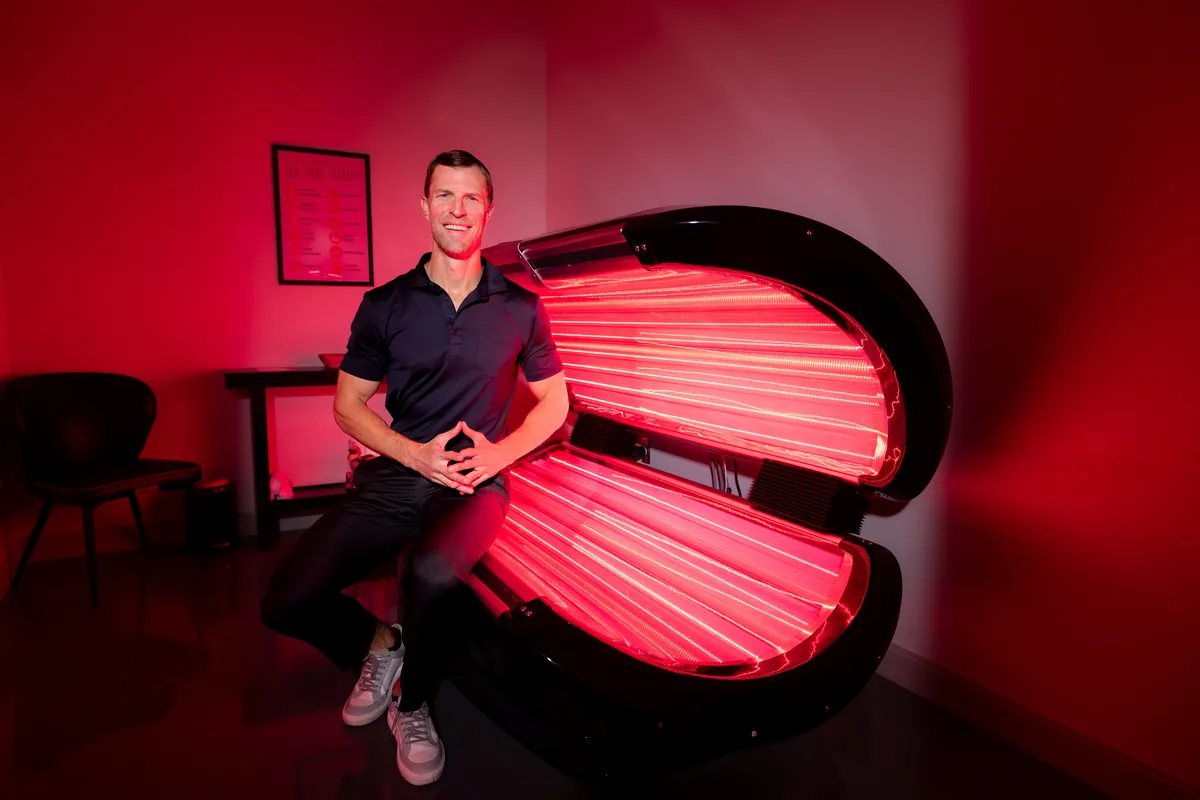
Acoustic pressure waves restart stalled healing in tendon and fascia, and near-infrared light at 850nm reaches the joint capsule to support mitochondrial function in the tissue. Both are drug-free and both have real trial support.
What the evidence showsPhotobiomodulation has meta-analysis support for reducing pain in musculoskeletal conditions, with near-infrared wavelengths penetrating to the joint capsule.Reduce the Load Where It Is Excessive
Every pound of body weight translates to several pounds of force through the knee with each step. This is not a lecture — it is mechanics, and it is why the metabolic work on this page matters to a joint.
What the evidence showsProlozone and regenerative injections prompt a controlled local repair response rather than suppressing inflammatory signalling, addressing the environment rather than blocking the pain signal.What patients commonly experience under our care
When patients receive the proper guidance, here is what they commonly experience under our care.
- Weeks 1–3 — morning stiffness. Usually the first thing to shift once inflammatory load starts falling. Patients describe the first half hour of the day becoming ordinary again.
- Weeks 3–8 — pain with activity. As muscle strengthens around the joint and inflammatory signalling reduces, the pain that limited walking, stairs or training begins to ease. This is where consistency matters most.
- Weeks 8–12 — the panel moves. hs-CRP falling. Omega-3 index climbing. Vitamin D reaching optimal. Fasting insulin coming down. The objective evidence that the inflammatory pressure on the joint has genuinely changed.
- Months 3–6 — function. The measure that matters. Range of motion, walking distance, ability to train, and for many patients a reduction in how much anti-inflammatory medication they need.
If you have been told to take an anti-inflammatory and come back when it is bad enough for surgery, there is a great deal of ground in between that nobody has offered you. Schedule a consultation and let my team find what is actually driving the inflammation, and build a plan that addresses the joint and the terrain around it. We will not stop until the root cause of every one of your health issues has been found and addressed.
Inflammatory markers, metabolic drivers and regenerative options — assessed properly rather than assumed.
Common questions
Why does my joint pain not heal?
Because cartilage has no blood supply. It is avascular, and receives nutrients only by being compressed and released as you move, which means repair is slow and limited compared with tissue that circulation reaches directly. It also means movement is genuinely part of the treatment rather than something to avoid.
Is arthritis just wear and tear?
No, and that framing has held back treatment for decades. Inflammatory cytokines actively participate in cartilage breakdown, which is why metabolic and dietary factors influence how quickly a joint degrades. It also explains why imaging and symptoms correlate so poorly — how inflamed a joint is matters as much as how worn it is.
Does curcumin work as well as ibuprofen for joint pain?
Several randomised trials have found curcumin comparable to NSAIDs for osteoarthritis pain with a considerably better side effect profile. The important caveat is form: ordinary turmeric powder has famously poor absorption, and the trial results come from enhanced-absorption preparations, usually phospholipid-bound.
What is prolozone?
Ozone injected into a joint or soft tissue alongside nutrients and a local anaesthetic. Rather than suppressing the pain signal, it prompts a local repair response. It is one of the options in the middle ground between anti-inflammatories and surgery, and it is a different therapy from systemic ozone that happens to use the same gas.
Is there a joint pain doctor near Nashville who does more than prescribe anti-inflammatories?
Yes. We are at 329 S. Royal Oaks Blvd in Franklin, Tennessee, about twenty minutes south of downtown Nashville. We work up the inflammatory and metabolic drivers, and we offer shockwave and red light therapy alongside nutritional and movement work.
- Fransen M, McConnell S, Harmer AR, et al. Exercise for osteoarthritis of the knee. Cochrane Database of Systematic Reviews. 2015;1:CD004376.
- Daily JW, Yang M, Park S. Efficacy of turmeric extracts and curcumin for alleviating the symptoms of joint arthritis: a systematic review and meta-analysis of randomized clinical trials. Journal of Medicinal Food. 2016;19(8):717–729. PMC5003001
- Berenbaum F. Osteoarthritis as an inflammatory disease. Osteoarthritis and Cartilage. 2013;21(1):16–21.
- Sokolove J, Lepus CM. Role of inflammation in the pathogenesis of osteoarthritis. Therapeutic Advances in Musculoskeletal Disease. 2013;5(2):77–94. PMC3638313
- Bjordal JM, et al. A systematic review of low level laser therapy with location-specific doses for pain from chronic joint disorders. Australian Journal of Physiotherapy. 2003. PMID 12580887
This article is educational and reflects the published literature as of August 2026. It is not a diagnosis or a treatment recommendation for any individual, and any decision about your care belongs in a conversation with a licensed practitioner who has seen your history and your labs.